
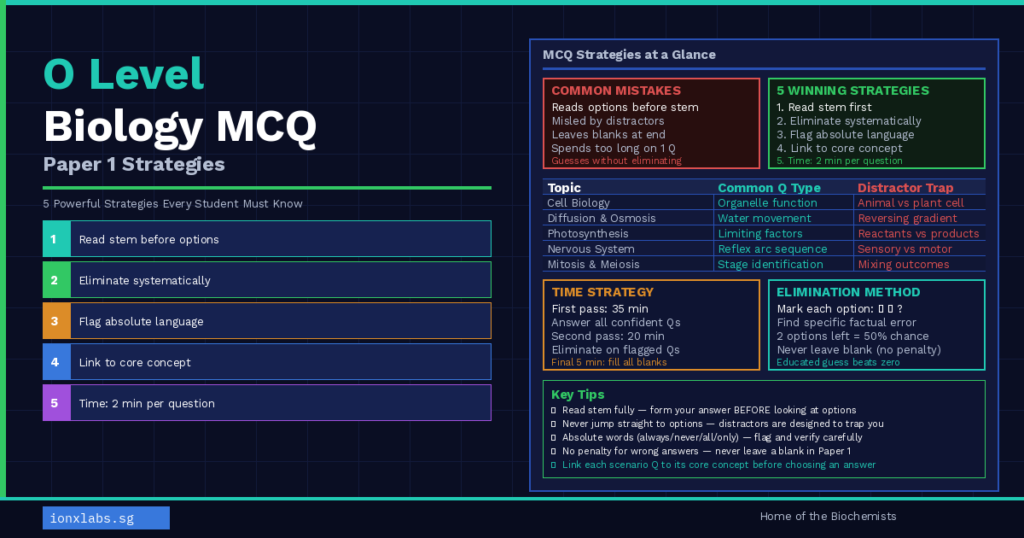
O Level Biology MCQ: 5 Powerful Strategies Every Student Must Know
O level biology MCQ questions are where Singapore students lose the most preventable marks in the entire Biology paper. Paper 1 carries 30 marks — a full 30% of the total assessment — yet most students treat MCQ preparation as an afterthought, spending the bulk of their revision time on structured essays and data questions. The result is predictable: students who understand Biology deeply still drop 6 to 10 marks on Paper 1 through avoidable errors.
This guide covers 5 powerful O level biology MCQ strategies that every Singapore student must know — from elimination technique to managing time pressure — with worked examples from common question types.
You can refer to the official SEAB O Level Biology syllabus (6093) to confirm which topics appear most frequently in O level biology MCQ questions.
Why O Level Biology MCQ Questions Are Harder Than They Look
The most common mistake students make with O level biology MCQ is treating each question as a simple knowledge check. In reality, SEAB MCQ questions are carefully written to test understanding, not just memory — and the wrong options (called distractors) are specifically designed to trap students who have partial or superficial knowledge.
A student who has memorised the definition of osmosis may still choose the wrong answer if they do not fully understand how it applies to a cell in a solution with a specific concentration. A student who knows the stages of mitosis may still be caught out by a question that asks about a specific phase diagram rather than a list. O level biology MCQ questions reward depth, not breadth.
Strategy 1 — Read the Question Stem Before Looking at the Options
The single most important O level biology MCQ technique is to read the question stem completely and identify exactly what is being asked — before looking at any of the four options. Students who jump straight to the options are immediately influenced by the distractors, which are written to seem plausible.
Before looking at the options, ask yourself:
- What is this question actually asking? (definition, application, comparison, or prediction)
- Which topic area does this fall under?
- What do I already know about this topic that is directly relevant?
- Can I form an answer in my head before reading the options?
If you can predict the correct answer before reading the options, you are far less likely to be misled by distractors. This is especially powerful for O level biology MCQ questions on topics like diffusion and osmosis, where the correct answer depends on precisely understanding concentration gradients — and all four options may look superficially plausible.
Strategy 2 — Use Process of Elimination Systematically
When you are not immediately confident of the answer, elimination is the most reliable technique for Paper 1. Work through each option and actively look for reasons to eliminate it — not reasons to keep it.
The elimination process:
- Read each option and mark it: ✓ (definitely correct), ✗ (definitely wrong), or ? (possibly correct)
- Focus first on options you can definitively eliminate — even removing one option changes your odds from 25% to 33%
- For each option you want to eliminate, identify the specific factual error — not just a feeling that it is wrong
- If you are left with two plausible options, look for the subtle distinction — SEAB questions always have one clearly correct answer
Process of elimination is particularly powerful for O level biology MCQ questions on the human nervous system, where distractors often reverse sensory and motor neurone roles, or misplace a stage in the reflex arc. Our guide on the human nervous system O level covers exactly the distinctions that MCQ distractors exploit.
Strategy 3 — Watch for Absolute Language in Options
One of the most reliable heuristics in Paper 1 is to be suspicious of options that contain absolute language — words like “always”, “never”, “all”, or “only”. In biology, very few statements are universally true without exception, and SEAB question writers know this.
Examples of how absolute language signals a wrong answer:
- “All cells always have a cell wall” — wrong, animal cells do not
- “Osmosis only occurs across partially permeable membranes” — this is actually correct, making it a trap for students who are suspicious of “only”
- “Active transport never requires energy” — clearly wrong
The key is not to automatically eliminate options with absolute language — it is to flag them and verify carefully. This strategy saves time by directing your scrutiny to the most likely distractor candidates in each question.
Strategy 4 — Link MCQ Questions Back to Core Concepts
Many O level biology MCQ questions are application questions in disguise — they present a novel scenario and ask which option correctly applies a biological principle. The students who score highest on these questions are those who have a strong grasp of the underlying concept, not just the surface facts.
For every O level biology MCQ question that involves a scenario, identify the core concept being tested:
- A question about water movement in plant cells → core concept is osmosis and water potential
- A question about why a muscle contracts after a stimulus → core concept is the reflex arc and motor neurone function
- A question about offspring ratios → core concept is Mendelian genetics and probability
- A question about gas exchange in a leaf → core concept is photosynthesis, respiration, and diffusion
Building strong core concept understanding across topics like cell biology, mitosis and meiosis, and photosynthesis is the foundation of strong O level biology MCQ performance.
Strategy 5 — Manage Time and Never Leave a Blank
O level biology MCQ Paper 1 has 30 questions in 1 hour — an average of 2 minutes per question. Time management is a skill in itself. Students who spend 5 minutes on a difficult question early in the paper often run out of time for easier questions at the end.
The optimal O level biology MCQ time strategy:
- First pass: answer every question you are confident about immediately — aim to complete this in 35 minutes
- Second pass: return to flagged questions with your remaining 20 minutes — use elimination on each one
- Final 5 minutes: check that every question has an answer — there is no penalty for guessing in O level biology MCQ, so a blank is always worse than a guess
- If completely unsure between two options, choose the one that aligns with the most fundamental biological principle
Never leave an O level biology MCQ question blank. With four options, a random guess gives you a 25% chance of a mark. An educated guess after eliminating two options gives you 50%. Either is better than zero.
The Most Commonly Tested Topics in O Level Biology MCQ
Based on past SEAB papers, these topics appear most frequently in O level biology MCQ questions and deserve focused revision:
| Topic | Common MCQ Question Types | Key Distractor Traps |
|---|---|---|
| Cell Biology | Cell structure, organelle function | Mixing animal and plant cell structures |
| Diffusion & Osmosis | Direction of water movement | Reversing high/low concentration gradient |
| Photosynthesis | Limiting factors, word equations | Confusing reactants and products |
| Nervous System | Reflex arc, neurone types | Reversing sensory and motor neurone roles |
| Mitosis & Meiosis | Stage identification, cell diagrams | Mixing mitosis and meiosis outcomes |
How to Practise O Level Biology MCQ Effectively
The most effective way to improve O level biology MCQ scores is timed past paper practice with detailed error analysis. After each practice session, categorise every wrong answer: was it a knowledge gap, a misread question, a distractor trap, or a time pressure error? Each category requires a different fix.
For knowledge gaps, return to the relevant topic guide — our posts on human digestion O level and diffusion and osmosis O level are good starting points for two of the highest-frequency MCQ topics. For distractor traps, practise the elimination strategy on every question — even the ones you get right — until it becomes automatic.
Improve Your O Level Biology MCQ Score With Expert Tuition
At IONX Labs Learning Centre, our O Level Biology classes include dedicated MCQ drilling — timed practice sets, group elimination exercises, and distractor analysis. With a maximum of 8 students per class, every student’s MCQ errors are reviewed individually, and the specific knowledge gaps behind each wrong answer are identified and addressed.
If self-study alone is not moving your MCQ scores, find out more about our O Level Biology tuition programme. Our post on biology tuition Singapore explains exactly when structured support makes the biggest difference.
📲 WhatsApp us today to find out more or to book your first session.
No commitment required — just a conversation about how we can help your child score better in Biology.
Frequently Asked Questions
How do you get full marks on O Level Biology MCQ?
To score full marks on O level biology MCQ, use five strategies consistently: read the question stem before looking at options, use systematic process of elimination, watch for absolute language in options, link each question back to the core biological concept being tested, and manage your time with a first-pass and second-pass approach. Never leave a blank — there is no penalty for guessing and an educated guess after eliminating two options gives you a 50% chance of a correct mark.
Why do students lose marks on O Level Biology Paper 1?
The most common reasons students lose marks on O level biology MCQ Paper 1 are: jumping to options before fully reading the question, being misled by distractors designed to exploit partial knowledge, reversing key concepts (e.g. sensory vs motor neurone), confusing mitosis and meiosis outcomes, and running out of time on difficult questions and leaving blanks. Most of these are technique errors, not knowledge gaps — which is why MCQ strategy practice is as important as content revision.
How much time should you spend on each O Level Biology MCQ question?
O level biology MCQ Paper 1 has 30 questions in 1 hour — an average of 2 minutes per question. The recommended strategy is a first pass of 35 minutes covering all questions you are confident about, followed by a second pass of 20 minutes on flagged questions using elimination, and a final 5 minutes to check all answers are filled in. If stuck between two options after elimination, choose the one that aligns with the most fundamental biological principle and move on.
Which topics come up most often in O Level Biology MCQ?
Based on past SEAB papers, the most frequently tested O level biology MCQ topics are: cell biology (organelle functions and cell structure), diffusion and osmosis (direction of water movement), photosynthesis (limiting factors and equations), the human nervous system (reflex arc and neurone types), and mitosis and meiosis (stage identification and cell diagrams). These five topics together account for a significant proportion of Paper 1 questions across most examination years.
Where can I find the official O Level Biology syllabus for Singapore?
You can download the official SEAB O Level Biology syllabus (6093) at https://www.seab.gov.sg/files/O%20Lvl%20Syllabus%20Sch%20Cddts/2025/6093_y25_sy.pdf