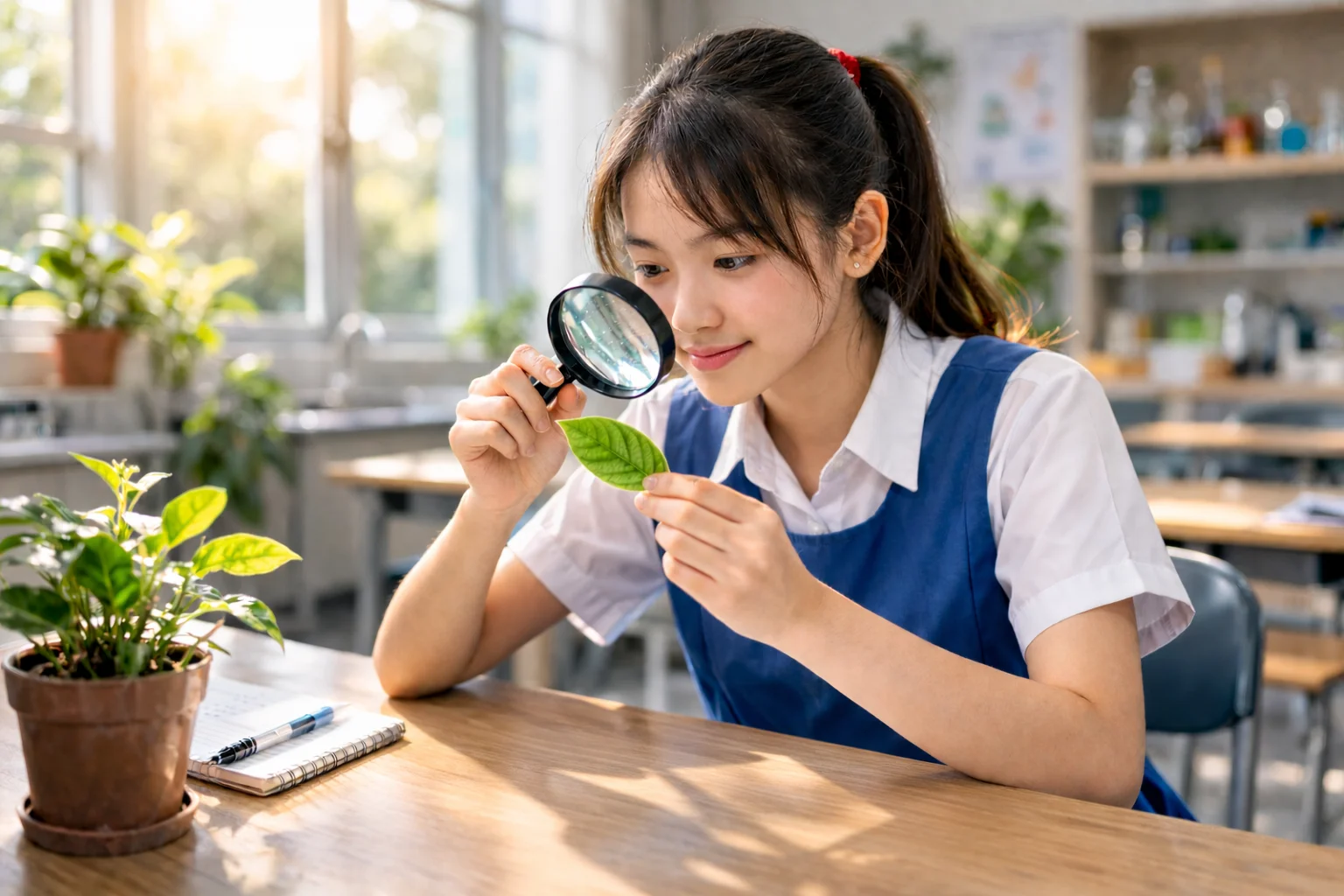
Photosynthesis is one of the most fundamental biological processes on Earth, and one of the most reliably tested topics in the Singapore O Level Biology paper. Understanding it is not just about memorising an equation. It connects to nutrition, respiration, ecosystems, the carbon cycle, and cell biology.
This guide answers what is photosynthesis in clear, exam-ready language, breaks down the 5 facts every student must know, and shows you how to study this topic so that every mark is within reach.
You can refer to the official SEAB O Level Biology syllabus (6093) to see exactly where photosynthesis sits within the full examination framework.
What Is Photosynthesis?
Photosynthesis is the process by which green plants, algae, and some bacteria use light energy to convert carbon dioxide and water into glucose and oxygen. It is the primary way that energy from the sun enters the food chain.
The overall equation for photosynthesis that every O Level student must memorise is:
In word form: Carbon dioxide + Water → Glucose + Oxygen
Why Is Photosynthesis So Important for O Level Biology?
Photosynthesis connects directly to several other topics in the O Level Biology syllabus:
- Nutrition in plants: photosynthesis is how plants make their own food
- Respiration: glucose produced by photosynthesis is the fuel for cellular respiration
- Ecosystems and food chains: plants as producers depend entirely on photosynthesis
- The carbon cycle: photosynthesis removes CO₂ from the atmosphere
- Cell biology: photosynthesis occurs in chloroplasts, linking directly to cell biology and organelle function
5 Facts About Photosynthesis Every O Level Student Must Know
Fact 1: Photosynthesis Occurs in the Chloroplasts
Photosynthesis occurs specifically inside chloroplasts, organelles found in the cells of green plant tissue. Chloroplasts contain a green pigment called chlorophyll, which absorbs light energy (mainly red and blue wavelengths) to power the photosynthesis reaction.
This is why leaves are green. Chlorophyll reflects green light rather than absorbing it. A common exam question asks students to explain why variegated leaves (which have white patches without chlorophyll) cannot photosynthesise in the white areas.
Fact 2: Light, Carbon Dioxide, and Water Are the Three Raw Materials
For photosynthesis to occur, three things must be present:
- Light energy: absorbed by chlorophyll, provides the energy to drive the reaction
- Carbon dioxide (CO₂): absorbed from the air through tiny pores called stomata on the leaf surface
- Water (H₂O): absorbed from the soil through the roots and transported up the stem
Remove any one of these, and photosynthesis stops. This is why the limiting factors of photosynthesis are such an important part of the syllabus.
Fact 3: Glucose and Oxygen Are the Two Products
Photosynthesis produces two outputs:
- Glucose (C₆H₁₂O₆): used by the plant for energy (via respiration), growth, and storage (converted to starch)
- Oxygen (O₂): released into the atmosphere as a by-product through the stomata
A common exam trap: students are asked where glucose goes after photosynthesis. The correct answer covers multiple uses, namely respiration, conversion to starch for storage, conversion to cellulose for cell walls, and conversion to amino acids with the addition of nitrogen. Know all four.
Fact 4: Three Factors Limit the Rate of Photosynthesis
Limiting factors are conditions that, when in short supply, slow down the rate of photosynthesis even if all other conditions are ideal. The three main limiting factors at O Level are:
| Limiting Factor | Effect When Increased | Maximum Effect |
|---|---|---|
| Light intensity | Rate of photosynthesis increases | Plateaus when another factor becomes limiting |
| CO₂ concentration | Rate of photosynthesis increases | Plateaus when another factor becomes limiting |
| Temperature | Rate increases up to optimum (~25–30°C) | Drops sharply above optimum (enzymes denature) |
Graph interpretation questions on limiting factors appear in almost every O Level Biology paper. Practise reading and explaining these graphs: state the trend, identify the limiting factor at each stage, and explain what happens at the plateau.
Fact 5: You Can Test for Photosynthesis Using Standard Experiments
O Level Biology requires you to understand two classic practical experiments:
- Starch test: to test whether a leaf has photosynthesised. Steps: boil leaf in water (to kill cells), boil in ethanol using a water bath (to remove chlorophyll), rinse with water, add iodine solution. A blue-black colour confirms starch is present.
- Testing for oxygen production: using aquatic plants (e.g. Elodea), count the rate of bubble production under different light conditions to measure the rate of photosynthesis.
Examiners often ask you to describe the experimental setup, state the variable being tested, and explain the results. Practise writing these answers in full. Every step matters.
How to Study Photosynthesis Effectively for O Level Biology
Memorise the Equation in Both Forms
Write the word equation and the balanced symbol equation from memory daily until they are automatic. Most students lose marks here not because they don't understand photosynthesis, but because they write an unbalanced or incorrect equation under exam pressure.
Practise Graph Questions on Limiting Factors
Limiting factor graphs are a guaranteed part of the O Level Biology paper. Work through past year papers and practise reading, describing, and explaining these graphs until the structure of your answer is second nature. Much of the answering technique carries across between subjects, so our guide on O Level Chemistry exam tips is worth reading for the command word and phrasing sections.
Connect Photosynthesis Back to Cell Biology
Every photosynthesis question ultimately links back to chloroplasts. If you built a solid understanding of cell biology, particularly organelle structure and function, you will find photosynthesis questions significantly easier to answer in full.
What Most Students Get Wrong in Photosynthesis Exam Answers
The most common mistakes are: confusing photosynthesis with respiration, forgetting that glucose has multiple uses beyond energy, and misreading limiting factor graphs. These are exactly the errors that cost students marks they should be getting.
At IONX Labs, O Level Biology classes are structured so students understand photosynthesis at a deep enough level to handle any exam question variation, not just the standard ones. Tutors work through real past paper questions, targeting the specific errors that cost students marks.
Get Help With Photosynthesis O Level Biology
IONX Labs O Level Biology classes are small and focused, capped at 8 students, and built around the Singapore syllabus. Find out more about our O Level Biology tuition programme.
WhatsApp to Book → Our Biology Programme