
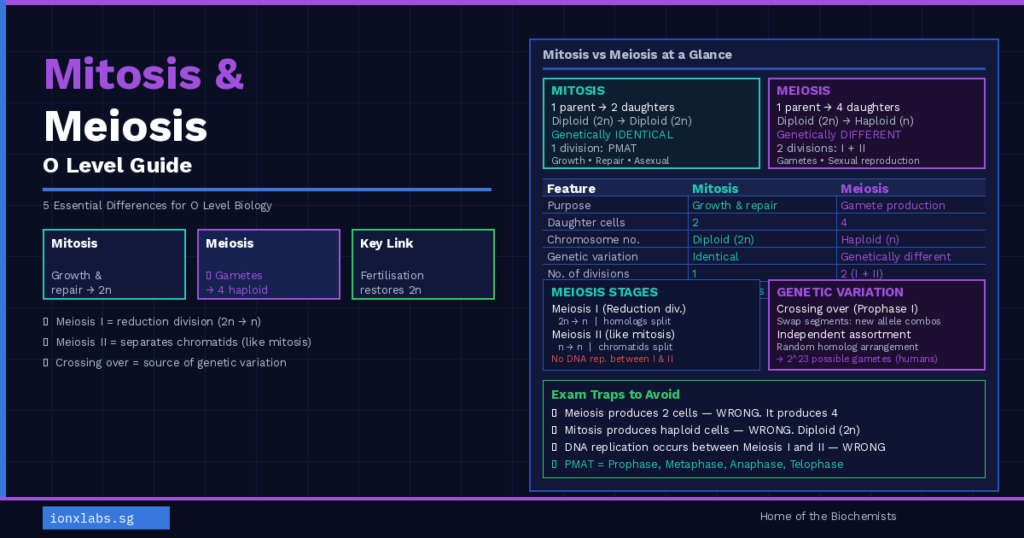
Mitosis and Meiosis O Level: 5 Essential Differences Every Student Must Know
Mitosis and meiosis O level Biology is one of the most commonly tested and most commonly confused topics in the entire Singapore Biology syllabus. Both are types of cell division, but they serve completely different purposes, produce different types of cells, and follow different processes. Getting mitosis and meiosis O level content wrong in an exam almost always comes down to mixing up which division does what.
This guide breaks down the 5 essential differences between mitosis and meiosis O level students must know, explains each stage clearly, and gives you the exam answer strategies you need to score full marks.
You can refer to the official SEAB O Level Biology syllabus (6093) to confirm exactly which aspects of cell division are examinable.
What Are Mitosis and Meiosis? The O Level Definitions
Mitosis is a type of cell division that produces two genetically identical daughter cells, each with the same number of chromosomes as the parent cell. It is used for growth, repair, and asexual reproduction.
Meiosis is a type of cell division that produces four genetically different daughter cells, each with half the number of chromosomes as the parent cell. It is used exclusively for the production of gametes (sex cells — sperm and eggs in animals, pollen and ovules in plants).
Both processes begin with a diploid parent cell (2n chromosomes). The key distinction is what comes out at the end — and why. Understanding this distinction is the foundation of all mitosis and meiosis O level exam questions.
5 Essential Differences Between Mitosis and Meiosis O Level Students Must Know
Difference 1: Purpose
Mitosis is used for growth, repair of tissues, and asexual reproduction. Every time your body replaces old skin cells, repairs a wound, or a plant grows new leaves, mitosis is occurring. Meiosis is used exclusively for the production of gametes — sex cells involved in sexual reproduction. Meiosis only occurs in the reproductive organs (testes and ovaries in animals; anthers and ovaries in flowering plants).
Difference 2: Number of Daughter Cells Produced
Mitosis produces 2 daughter cells from one parent cell. Meiosis produces 4 daughter cells from one parent cell. This is because meiosis involves two rounds of division — Meiosis I and Meiosis II — whereas mitosis involves only one round of division.
Difference 3: Chromosome Number
This is the most tested difference in mitosis and meiosis O level papers. In mitosis, the daughter cells are diploid (2n) — they have the same number of chromosomes as the parent cell. In meiosis, the daughter cells are haploid (n) — they have half the number of chromosomes as the parent cell. For humans, this means mitosis produces cells with 46 chromosomes, while meiosis produces gametes with 23 chromosomes each. When two gametes fuse at fertilisation, the diploid number (46) is restored.
Difference 4: Genetic Variation
Mitosis produces daughter cells that are genetically identical to the parent cell and to each other — the DNA is copied exactly. Meiosis produces daughter cells that are genetically different from each other and from the parent cell. This genetic variation occurs through two mechanisms: crossing over (exchange of genetic material between homologous chromosomes during Meiosis I) and independent assortment (random arrangement of homologous chromosome pairs). This genetic variation is essential for evolution and adaptation.
Difference 5: Number of Divisions
Mitosis involves one division of the nucleus followed by cytoplasmic division (cytokinesis). Meiosis involves two consecutive divisions — Meiosis I (the reduction division, which separates homologous chromosome pairs) and Meiosis II (which separates sister chromatids, similar to mitosis). DNA replication occurs only once before meiosis begins — there is no DNA replication between Meiosis I and Meiosis II.
Mitosis vs Meiosis O Level: Summary Comparison Table
| Feature | Mitosis | Meiosis |
|---|---|---|
| Purpose | Growth, repair, asexual reproduction | Gamete production (sexual reproduction) |
| Daughter cells produced | 2 | 4 |
| Chromosome number | Diploid (2n) — same as parent | Haploid (n) — half of parent |
| Genetic variation | No — genetically identical | Yes — genetically different |
| Number of divisions | 1 | 2 (Meiosis I + Meiosis II) |
| Where it occurs | All body (somatic) cells | Reproductive organs only |
This comparison table is the single most important revision tool for mitosis and meiosis O level — learn every row and be ready to reproduce it from memory in both structured question and free-response formats.
The Stages of Mitosis: What O Level Students Need to Know
At O Level, you are expected to know the stages of mitosis and be able to identify cells at each stage from diagrams. The four stages are:
- Prophase — chromosomes condense and become visible; the spindle forms; nuclear envelope breaks down
- Metaphase — chromosomes line up along the equator (middle) of the cell; spindle fibres attach to centromeres
- Anaphase — sister chromatids are pulled apart to opposite poles of the cell by spindle fibres
- Telophase — chromosomes reach the poles; nuclear envelopes reform; chromosomes uncoil; cytokinesis occurs, producing two daughter cells
A useful memory aid: PMAT — Prophase, Metaphase, Anaphase, Telophase.
Meiosis I and Meiosis II: The Key Points for O Level
Meiosis occurs in two stages. Meiosis I is the reduction division — homologous chromosome pairs are separated, halving the chromosome number. Crossing over occurs during Prophase I, generating genetic variation. Meiosis II is similar to mitosis — sister chromatids are separated. No DNA replication occurs between the two divisions.
The key point for exam answers: after Meiosis I, the cells are haploid but each chromosome still consists of two chromatids. After Meiosis II, the chromatids separate, giving four haploid cells each with single-stranded chromosomes.
Why Meiosis Is Essential for Sexual Reproduction
Without meiosis, sexual reproduction would double the chromosome number with every generation. Meiosis ensures that gametes carry only half the genetic information (haploid), so that when two gametes fuse at fertilisation, the normal diploid number is restored in the offspring. This is also connected to the topic of inheritance — understanding how alleles are separated and recombined during meiosis is fundamental to genetics. Our guide on cell biology O level covers the structure of chromosomes and DNA that underpins this topic.
The genetic variation produced by meiosis (through crossing over and independent assortment) is also the raw material for natural selection and evolution — a key concept in the O Level Biology syllabus.
Common Mistakes in Mitosis and Meiosis O Level Exam Answers
The most frequent errors students make in mitosis and meiosis O level questions are stating that meiosis produces 2 cells (it produces 4), confusing which division is haploid and which is diploid, and failing to mention crossing over when asked about sources of genetic variation. Another common mistake is writing that “meiosis produces genetically identical cells” — this is the opposite of correct.
In diagram questions, students often misidentify the stage of mitosis because they confuse metaphase (chromosomes at the equator) with anaphase (chromosomes being pulled apart). When in doubt, look at where the chromosomes are — at the middle = metaphase, moving to the poles = anaphase.
If you are finding this topic challenging alongside others in Sec 4 Biology, our guide on human digestion O level and diffusion and osmosis O level are useful companion reads — cell processes are deeply interconnected across the syllabus.
How to Study Mitosis and Meiosis O Level Effectively
Draw Both Divisions from Memory
The most effective way to revise mitosis and meiosis O level content is to draw both processes from scratch — showing the chromosome positions at each stage — until you can do it in under five minutes without notes. Use a simple cell with four chromosomes (2n=4) for clarity.
Memorise the Comparison Table
Reproduce the 6-row comparison table from memory at least three times before your exam. Questions asking you to compare mitosis and meiosis are structured answer questions worth 4–6 marks each — the table gives you every answer you need.
Link to Genetics and Reproduction Topics
Meiosis connects directly to inheritance — the random assortment of alleles during Meiosis I is why offspring inherit different combinations from each parent. Understanding the cell biology of meiosis makes genetics questions significantly easier. Our guide on photosynthesis O level is another topic that links to cell biology through chloroplast structure and function.
Master Mitosis and Meiosis O Level With Expert Biology Tuition
At IONX Labs Learning Centre, our O Level Biology classes cover mitosis and meiosis O level in full — from understanding the purpose of each division to drawing accurate stage diagrams and writing mark-scoring comparison answers. Our small class sizes (maximum 8 students) mean every student gets the individual attention needed to master these distinctions.
Find out more about our O Level Biology tuition programme.
📲 WhatsApp us today to find out more or to book your first session.
No pressure — just a conversation about how we can help your child score better in Biology.
Frequently Asked Questions
What are the 5 key differences between mitosis and meiosis for O Level Biology?
The 5 essential differences between mitosis and meiosis O level students must know are: (1) Purpose — mitosis is for growth and repair; meiosis is for gamete production; (2) Daughter cells — mitosis produces 2, meiosis produces 4; (3) Chromosome number — mitosis produces diploid (2n) cells, meiosis produces haploid (n) cells; (4) Genetic variation — mitosis produces identical cells, meiosis produces genetically different cells; (5) Number of divisions — mitosis has 1 division, meiosis has 2 (Meiosis I and Meiosis II).
What is the difference between diploid and haploid cells?
A diploid cell (2n) contains two complete sets of chromosomes — one from each parent. In humans, diploid cells have 46 chromosomes. A haploid cell (n) contains only one set of chromosomes — half the normal number. In humans, haploid cells (gametes) have 23 chromosomes. Meiosis produces haploid gametes so that when two gametes fuse at fertilisation, the normal diploid number is restored in the offspring.
What is crossing over and why does it matter in O Level Biology?
Crossing over is the exchange of genetic material between homologous chromosomes during Prophase I of meiosis. It is one of the two main sources of genetic variation in meiosis (the other is independent assortment). Crossing over produces new combinations of alleles in the gametes, meaning offspring receive unique genetic combinations not present in either parent. This is a key source of variation tested in O Level Biology genetics questions.
What are the 4 stages of mitosis?
The 4 stages of mitosis are: (1) Prophase — chromosomes condense, spindle forms, nuclear envelope breaks down; (2) Metaphase — chromosomes line up at the equator of the cell; (3) Anaphase — sister chromatids are pulled to opposite poles by spindle fibres; (4) Telophase — nuclear envelopes reform, chromosomes uncoil, cytokinesis produces two daughter cells. Remember the stages using the acronym PMAT.
Where can I find the official O Level Biology syllabus for Singapore?
You can download the official SEAB O Level Biology syllabus (6093) from the SEAB website at https://www.seab.gov.sg/files/O%20Lvl%20Syllabus%20Sch%20Cddts/2025/6093_y25_sy.pdf