
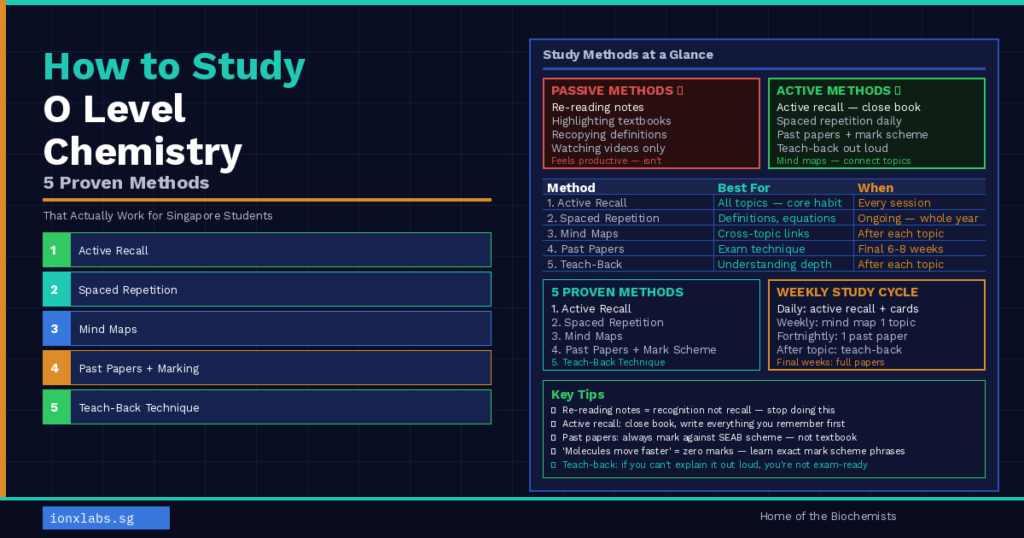
How to Study O Level Chemistry: 5 Proven Methods That Actually Work
How to study O level chemistry is one of the most searched questions by Singapore Sec 3 and Sec 4 students — and the honest answer is that most students are using the wrong methods. Reading notes, highlighting textbooks, and recopying definitions feels productive but produces almost no exam-ready understanding. The students who score well in O Level Pure Chemistry are almost never the ones who studied the most hours. They are the ones who studied the right way.
This guide covers 5 proven methods for how to study O level chemistry effectively — based on what actually moves grades, not what feels comfortable. You can cross-reference these with the official SEAB Pure Chemistry syllabus (6092) to make sure your revision covers every examinable area.
Why Most Students Study O Level Chemistry the Wrong Way
Before covering how to study O level chemistry effectively, it is worth understanding why passive methods fail. Reading notes and watching videos creates a feeling of familiarity — students recognise content when they see it. But recognition is not recall. In an O Level Chemistry exam, nothing is in front of you. You must retrieve, apply, and construct answers from scratch under time pressure.
The gap between “I understood this when I read it” and “I can answer this exam question correctly” is where most O Level Chemistry marks are lost. Every method in this guide on how to study O level chemistry is designed to close that gap.
Method 1 — Active Recall Over Passive Re-reading
Active recall is the single most evidence-backed study method for how to study O level chemistry. Instead of re-reading notes, close the book and try to write down everything you remember about a topic from scratch. Then check what you missed and repeat.
Practical ways to apply active recall to O Level Chemistry:
- After reading a topic, close your notes and write the key definitions, equations, and reactions on a blank page
- Use flashcards — write the concept on one side, the answer on the other — and test yourself daily
- At the start of each revision session, try to recall what you covered in the last session before opening any notes
For calculation-heavy topics like stoichiometry and the mole concept, active recall means working problems without looking at worked examples first. Our guide on stoichiometry O level walks through the 4-step method you should be able to reproduce from memory — that is exactly the kind of active recall target to set yourself.
Method 2 — Spaced Repetition for Definitions and Equations
O Level Chemistry has a significant memorisation load — definitions, ionic equations, test for ions, colour changes, gas tests, and half equations all need to be retained accurately. The most efficient method for how to study O level chemistry memorisation content is spaced repetition: reviewing material at increasing intervals so it moves into long-term memory.
A simple spaced repetition schedule for O Level Chemistry:
- Review new content on Day 1, Day 3, Day 7, Day 14, and Day 30
- If you recall it correctly, push the next review further out
- If you forget it, reset the interval back to Day 1
This is especially effective for topics like electrolysis (half equations and electrode products), acids and bases (indicators, pH scale, reactions with metals and carbonates), and chemical bonding (dot-and-cross diagrams). Our guide on electrolysis O level lists all the standard half equations you need to have memorised — a ready-made spaced repetition list.
Method 3 — Mind Maps for Cross-Topic Connections
One of the most powerful methods for how to study O level chemistry is building mind maps that connect topics — not just summarise them. O Level Chemistry exam questions frequently test how topics relate to each other: rates of reaction connects to activation energy connects to chemical bonding; stoichiometry connects to mole concept connects to volumetric analysis.
How to build an effective O Level Chemistry mind map:
- Start with a core topic in the centre (e.g. “Acids and Bases”)
- Branch out to related concepts (neutralisation, salts, pH, indicators)
- Draw connections to other topics (salts → electrolysis; neutralisation → stoichiometry calculations)
- Use colour coding — one colour per topic area makes cross-topic links visually clear
Mind maps work best after you already understand a topic — they are a synthesis tool, not a learning tool. Build them after your first pass through a chapter, then use them for pre-exam review. See how acids, bases and salts O level connects to multiple other chemistry topics — a natural starting point for a cross-topic mind map.
Method 4 — Past Paper Practice With Mark Scheme Checking
No method for how to study O level chemistry is more directly exam-relevant than past paper practice — but only if done correctly. The critical step that most students skip is checking their answers against the actual SEAB mark scheme, not just the textbook answer.
How to use past papers effectively for O Level Chemistry:
- Do the paper under timed, exam conditions first — no notes, no checking mid-paper
- Mark using the official SEAB mark scheme — note every mark you lost and exactly why
- Categorise your errors: wrong concept, correct concept but wrong language, calculation error, or missed step
- For every wrong answer, write the correct mark scheme response in full before moving on
- Revisit the same question type two weeks later to check retention
Past paper practice is most powerful in the final 6–8 weeks before the O Level exams. For topics like rates of reaction O level, past papers reveal the specific phrases examiners always use — and those phrases need to be in your answer word for word.
Method 5 — Teach It Back to Lock In Understanding
The most underused method for how to study O level chemistry is the teach-back technique: after studying a topic, explain it out loud as if teaching it to someone who has never seen it before. This forces you to identify exactly where your understanding has gaps — because you cannot explain what you do not truly understand.
Practical teach-back approaches for O Level Chemistry:
- Explain a topic to a parent, sibling, or study partner — without notes
- Record yourself explaining a concept and play it back — gaps in your explanation are gaps in your understanding
- Write a one-page summary of a topic entirely in your own words, then check it against your notes
The teach-back method is particularly powerful for conceptual topics. Can you explain why increasing temperature increases reaction rate without using the words “molecules move faster”? If not, you are not exam-ready on that topic. Our post on chemical bonding O level is a good test — try explaining the difference between ionic, covalent, and metallic bonding out loud before checking your notes.
How to Study O Level Chemistry: Putting It All Together
| Method | Best For | When to Use |
|---|---|---|
| 1. Active Recall | All topics — core habit | Every revision session |
| 2. Spaced Repetition | Definitions, equations, reactions | Ongoing throughout the year |
| 3. Mind Maps | Cross-topic connections | After first pass through each topic |
| 4. Past Papers | Exam technique and mark scheme language | Final 6–8 weeks before exams |
| 5. Teach-Back | Checking depth of understanding | After completing a topic |
The most effective approach to how to study O level chemistry combines all five methods in a weekly cycle — not one method used exclusively. Active recall and spaced repetition form the daily habit; mind maps and teach-back consolidate after each topic; past papers build exam readiness in the final stretch.
When These Methods Are Not Enough
Even the best self-study methods have limits. If your child has significant knowledge gaps from earlier topics — particularly in foundational areas like the mole concept, atomic structure, or chemical bonding — self-study alone is unlikely to close those gaps before the O Level exams. The methods above assume the underlying understanding is there and just needs to be activated. When it is not, structured support makes a significant difference.
If you are wondering whether tuition is the right next step alongside these study methods, our post on chemistry tuition Singapore explains exactly when and why structured tuition adds value — and what to look for in a centre.
Get Expert Guidance on How to Study O Level Chemistry
At IONX Labs Learning Centre, we build all five of these methods for how to study O level chemistry into our classes — active recall through in-class questioning, spaced repetition through our structured topic schedule, mind maps as consolidation tools, past paper drilling with SEAB mark schemes, and teach-back through student explanation exercises. With a maximum of 8 students per class, every student’s understanding is checked every session.
Find out more about our O Level Pure Chemistry tuition programme, or read our existing guide on how to study chemistry effectively for additional strategies.
📲 WhatsApp us today to find out more or to book your first session.
No commitment required — just a conversation about how we can help your child score better in Chemistry.
Frequently Asked Questions
What is the best way to study O Level Chemistry in Singapore?
The most effective approach to how to study O level chemistry combines five methods: active recall (testing yourself rather than re-reading), spaced repetition (reviewing content at increasing intervals), mind maps (connecting topics across the syllabus), past paper practice with SEAB mark schemes, and the teach-back technique (explaining topics out loud). Students who use all five in a weekly revision cycle consistently outperform those who rely on passive re-reading alone.
Are flashcards useful for O Level Chemistry?
Yes — flashcards are one of the most effective tools for how to study O level chemistry memorisation content. Use them for definitions, ionic equations, gas tests, ion tests, colour changes, and half equations. The key is to test yourself actively (look at the question, recall the answer before flipping) rather than just reading both sides passively. Digital flashcard apps that use spaced repetition algorithms make this even more efficient.
How many past papers should an O Level Chemistry student do?
For how to study O level chemistry with past papers, aim to complete at least 5 full past papers under timed exam conditions in the final 6–8 weeks before the O Level exams. More important than quantity is quality — every wrong answer should be analysed against the official SEAB mark scheme, and the correct response written out in full. Repeating the same question type two weeks later to check retention is more valuable than moving on to new papers immediately.
Why do students who understand chemistry still lose marks in exams?
The most common reason is mark scheme language — O Level Chemistry examiners mark to very precise wording, and answers that demonstrate understanding but use the wrong phrasing score zero. For example, explaining that “molecules move faster” when temperature increases earns no marks; the correct answer requires specific reference to kinetic energy, activation energy, and frequency of successful collisions. Learning how to study O level chemistry with mark schemes — not just textbooks — closes this gap.
Where can I find the official O Level Pure Chemistry syllabus?
You can download the official SEAB O Level Pure Chemistry syllabus (6092) at https://www.seab.gov.sg/files/O%20Lvl%20Syllabus%20Sch%20Cddts/2025/6092_y25_sy.pdf