Electrolysis O level is one of those topics that looks complicated on paper but becomes logical once you understand the underlying rules. It combines concepts from ionic bonding, electrical circuits, and oxidation-reduction, and it appears in almost every O Level Chemistry paper.
This guide breaks down the 5 facts about electrolysis O level students need, so you can approach every exam question on this topic with clarity and confidence.
You can download the official SEAB O Level Pure Chemistry syllabus (6092) to see exactly how electrolysis fits into the full examination framework.
What Is Electrolysis in O Level Chemistry?
Electrolysis is the decomposition of an ionic compound, when molten or in aqueous solution, by the passage of electricity. That is the definition worth writing in an exam. Put another way, electrical energy is used to drive a chemical reaction that would not happen on its own. You pass electricity through a liquid called an electrolyte, causing chemical changes at two electrodes, the cathode and the anode.
The electrolysis O level syllabus covers two main scenarios: electrolysis of molten compounds and electrolysis of aqueous solutions. Understanding which ions are present and which are preferentially discharged is the core skill examiners test.
5 Facts About Electrolysis Every O Level Student Must Know
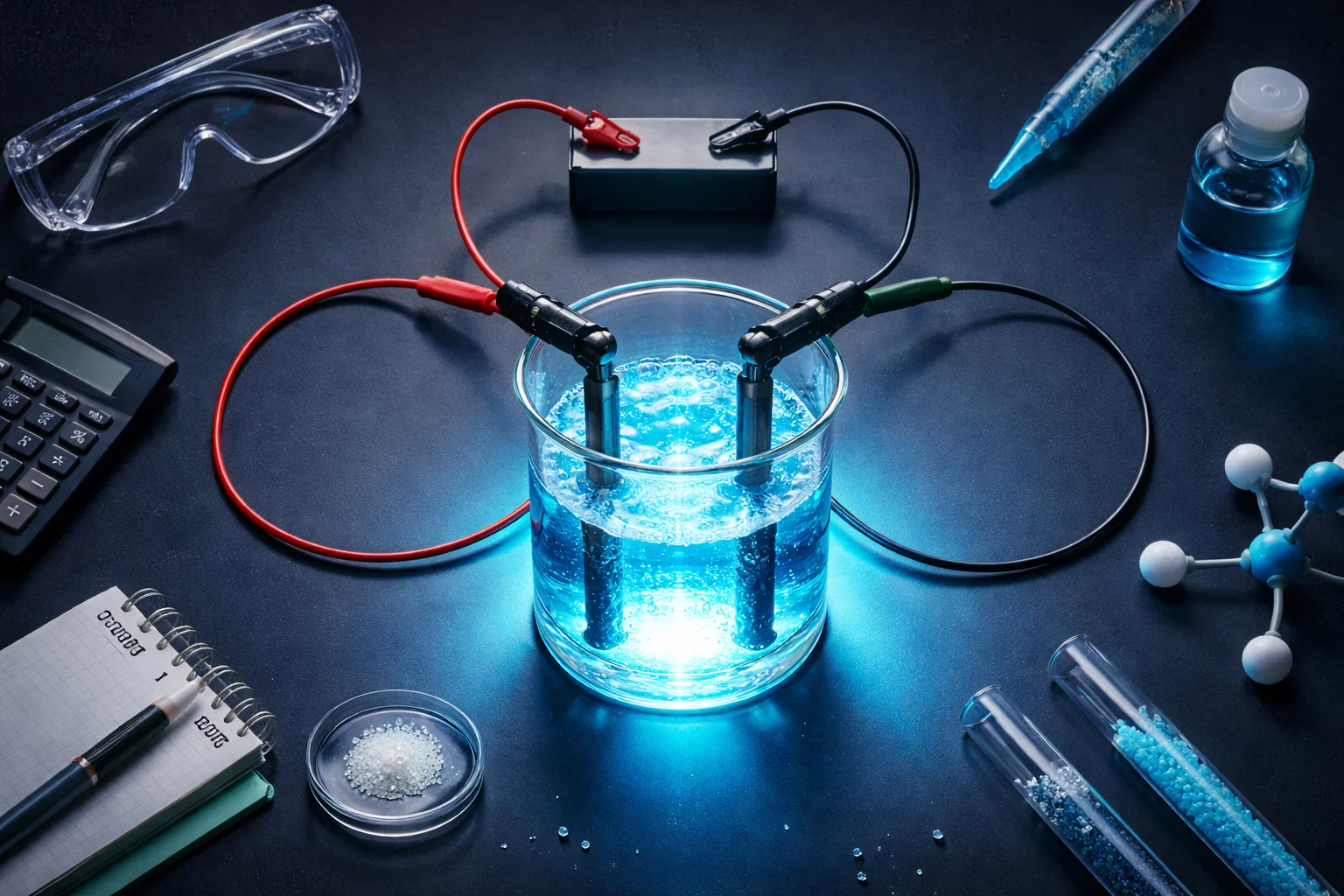
Fact 1: You Need an Electrolyte, Two Electrodes, and a Power Supply
For electrolysis to occur, three things must be in place:
- Electrolyte: a substance that conducts electricity when molten or dissolved in water, because it contains mobile ions. Examples: sodium chloride solution, copper sulfate solution, molten lead bromide
- Cathode: the negative electrode, connected to the negative terminal of the power supply
- Anode: the positive electrode, connected to the positive terminal of the power supply
A common exam question asks students to explain why a solid ionic compound cannot undergo electrolysis. The answer: ions are fixed in a lattice and cannot move, so there is no electrical conduction.
Fact 2: Cations Move to the Cathode, Anions Move to the Anode
Ion movement is one of the most fundamental rules in electrolysis O level chemistry, and one of the most frequently tested:
- Cations (positive ions) are attracted to the cathode (negative electrode), where they gain electrons and are reduced
- Anions (negative ions) are attracted to the anode (positive electrode), where they lose electrons and are oxidised
A reliable memory aid: OIL RIG, meaning Oxidation Is Loss (of electrons), Reduction Is Gain (of electrons). This applies at both electrodes and connects electrolysis directly to the broader redox chemistry topic.
Fact 3: Electrolysis of Molten Compounds Is Straightforward
When a pure ionic compound is melted (e.g. molten lead bromide, PbBr₂), only the ions from that compound are present. Predicting what forms at each electrode is then straightforward:
| Electrode | Ion Discharged | Product | Reaction Type |
|---|---|---|---|
| Cathode (−) | Pb²⁺ (lead ions) | Lead metal (grey deposit) | Reduction |
| Anode (+) | Br⁻ (bromide ions) | Bromine gas (brown fumes) | Oxidation |
You must be able to write the half-equations for both electrodes:
- Cathode: Pb²⁺ + 2e⁻ → Pb
- Anode: 2Br⁻ → Br₂ + 2e⁻
Fact 4: Aqueous Solutions Involve Selective Discharge
When an ionic compound is dissolved in water, H⁺ and OH⁻ ions from water are also present. At each electrode, competing ions exist, and only one will be preferentially discharged. The rules for selective discharge are:
At the cathode (reduction):
- If the metal is below hydrogen in the reactivity series → the metal ion is discharged (e.g. Cu²⁺ → Cu)
- If the metal is above hydrogen in the reactivity series → hydrogen is discharged instead (H⁺ → H₂)
At the anode (oxidation):
- If halide ions (Cl⁻, Br⁻, I⁻) are present in high concentration → the halide is discharged
- Otherwise → oxygen is discharged from OH⁻ ions
This is the most nuanced part of electrolysis O level content. It requires careful application of rules rather than rote memorisation, and understanding the reactivity series is essential here.
Fact 5: Electroplating Is an Application of Electrolysis
O Level students must understand how electrolysis is applied in electroplating, which means coating one metal with a thin layer of another to improve appearance or prevent corrosion.
In electroplating:
- The object to be plated is used as the cathode
- The plating metal is used as the anode
- The electrolyte is a solution of a salt of the plating metal
Example: silver plating a spoon. The spoon is the cathode, a silver bar is the anode, and silver nitrate solution is the electrolyte. Silver ions (Ag⁺) are reduced at the spoon surface, depositing a silver coating.
How to Study Electrolysis Effectively for O Level Chemistry
Master the Half-Equations
Every electrolysis question will either ask you to write a half-equation or identify products. Practise writing balanced half-equations for common ions: Cu²⁺, Pb²⁺, H⁺, Cl⁻, Br⁻, OH⁻, SO₄²⁻. If these are automatic, you can handle any exam variation.
Always Identify All Ions Present First
Before answering any electrolysis question, write down every ion present in the electrolyte, including H⁺ and OH⁻ from water for aqueous solutions. This habit prevents the most common mistake: forgetting that water contributes ions in aqueous electrolysis.
Link Electrolysis to Redox and the Reactivity Series
Electrolysis connects directly to redox chemistry (OIL RIG) and the reactivity series (for predicting cathode products in aqueous solutions). For tips on how to connect topics across the whole syllabus, read our guide on O Level Chemistry exam tips. If you are also working through acids, bases and salts and the mole concept, both appear alongside electrolysis in the higher-order questions of Paper 2.
What Most Students Get Wrong in Electrolysis Exam Answers
The most common mistakes are: confusing cathode and anode, forgetting H⁺ and OH⁻ ions in aqueous solutions, and writing unbalanced half-equations. These errors are entirely avoidable with the right preparation.
At IONX Labs, O Level Chemistry classes work through electrolysis systematically, from the basic setup to selective discharge rules and electroplating applications, using real past paper questions to build the exact skills examiners are looking for.
Get Help With Electrolysis O Level Chemistry
IONX Labs O Level Chemistry classes are capped at 8 students. Find out more about our O Level Pure Chemistry tuition programme and what results our students achieve.
WhatsApp to Book → Our Chemistry Programme