
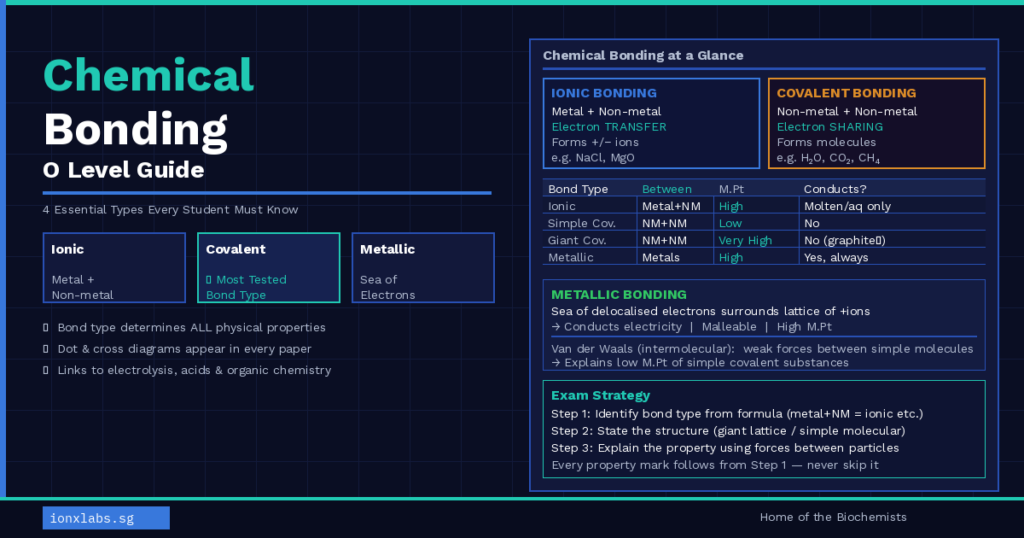
Chemical Bonding O Level: 4 Essential Types Every Student Must Master
Chemical bonding O level chemistry is one of those topics that underpins almost everything else in the syllabus. Once you understand why and how atoms bond together, topics like electrolysis, acids and bases, and organic chemistry all start to make much more sense. Get this right early, and you build a solid foundation for the entire Chemistry paper.
In this guide, we will break down the 4 essential types of chemical bonding O level students need to master, explain how to draw dot and cross diagrams correctly, and show you how to approach exam questions with confidence.
You can download the official SEAB O Level Pure Chemistry syllabus (6092) to see exactly where this topic sits within the full examination framework.
Why Chemical Bonding O Level Is So Important in Pure Chemistry
Understanding chemical bonding O level content is not just about memorising definitions. The type of bonding in a substance directly determines its physical properties — melting point, electrical conductivity, solubility — which are tested extensively across Paper 1 and Paper 2.
For example: why does sodium chloride have a high melting point? Because it has ionic bonding and a giant ionic lattice. Why does graphite conduct electricity? Because of delocalised electrons in its metallic-style layer structure. Every single property question links back to the bond type.
Students who struggle with this topic almost always share the same problem: they know the definitions but cannot apply them to explain properties. This guide will fix that.
The 4 Essential Types of Chemical Bonding O Level Students Must Know
Type 1: Ionic Bonding
Ionic bonding occurs between a metal and a non-metal. The metal atom loses one or more electrons to form a positive ion (cation), and the non-metal atom gains those electrons to form a negative ion (anion). The electrostatic attraction between the oppositely charged ions forms the ionic bond.
Key properties of ionic compounds:
- High melting and boiling points — strong electrostatic forces require a lot of energy to break
- Conduct electricity when molten or dissolved in water — ions are free to move
- Do not conduct electricity when solid — ions are fixed in the lattice
- Often soluble in water
Common exam example: sodium chloride (NaCl). Na loses 1 electron → Na⁺. Cl gains 1 electron → Cl⁻. This directly connects to the electrolysis topic — our guide on electrolysis O level explains how ionic compounds behave when a current is passed through them.
Type 2: Covalent Bonding
Covalent bonding is the most frequently tested type — it occurs between two non-metals. Instead of transferring electrons, the atoms share pairs of electrons to achieve a full outer shell. Each shared pair of electrons forms one covalent bond.
There are two covalent structures to know at O Level:
- Simple molecular structures (e.g. water H₂O, methane CH₄, chlorine Cl₂) — low melting points, do not conduct electricity, often gases or liquids at room temperature
- Giant covalent structures (e.g. diamond, silicon dioxide SiO₂) — very high melting points, do not conduct electricity (except graphite), very hard
Understanding covalent bonding is essential for organic chemistry — all organic molecules are held together by covalent bonds. See our guide on what is organic chemistry for how bonding applies across the carbon compounds topic.
Type 3: Metallic Bonding
Metallic bonding occurs in metals. Metal atoms lose their outer electrons to form a “sea” of delocalised electrons surrounding a lattice of positive metal ions. The electrostatic attraction between the positive ions and the delocalised electrons holds the structure together.
Key properties explained by metallic bonding:
- Good electrical conductors — delocalised electrons carry charge
- Good thermal conductors — delocalised electrons transfer energy
- Malleable and ductile — layers of ions can slide over each other without breaking the bond
- High melting points (generally) — strong attraction between ions and electron sea
Type 4: Intermolecular Forces (Van der Waals Forces)
While not a bonding type in the traditional sense, O level students must also understand intermolecular forces — the weak attractions between simple molecules. These are also called Van der Waals forces or instantaneous dipole-induced dipole forces.
- They are much weaker than ionic, covalent, or metallic bonds
- They explain why simple molecular substances have low melting and boiling points
- Larger molecules have stronger Van der Waals forces — this is why longer alkane chains have higher boiling points
How to Draw Dot and Cross Diagrams for Chemical Bonding O Level
Dot and cross diagrams are one of the most directly tested skills in the O level chemistry paper. Here is how to draw them correctly every time:
For Ionic Compounds
Draw the electron configurations of both ions in square brackets, with the charge shown outside. Show the transfer of electrons using an arrow in your working. Example: NaCl — Na has 1 dot electron transferred to Cl, leaving [Na]⁺ and [Cl]⁻ with full outer shells.
For Covalent Molecules
Draw both atoms with their outer shell electrons (use dots for one atom, crosses for the other). Show shared pairs between the atoms — each shared pair is one bond. Example: H₂O — oxygen shares one pair with each hydrogen atom, giving oxygen a full shell of 8 and each hydrogen a full shell of 2.
Common mistakes in dot and cross questions: forgetting to show lone pairs on the central atom, drawing the wrong number of bonds, or mixing up the number of outer shell electrons. Practise these diagrams until they are automatic.
Chemical Bonding O Level: Properties Summary Table
| Bond Type | Between | Melting Point | Conducts Electricity? |
|---|---|---|---|
| Ionic | Metal + Non-metal | High | Yes (molten/dissolved) |
| Simple Covalent | Non-metal + Non-metal | Low | No |
| Giant Covalent | Non-metal + Non-metal | Very High | No (except graphite) |
| Metallic | Metal atoms | High | Yes (always) |
This table is one of the most exam-ready summaries in chemical bonding O level content. Memorise the conductivity column in particular — it is tested in almost every paper.
How to Study Chemical Bonding O Level Effectively
Link Every Property to Its Bond Type
When you see a property question — “Explain why substance X has a high melting point” — your answer must always start by identifying the bond type and structure. Every mark in chemical bonding O level property questions flows from that first step. Practise identifying bond types from the formula alone: metal + non-metal = ionic, two non-metals = covalent, pure metal = metallic.
Drill Dot and Cross Diagrams Weekly
Draw dot and cross diagrams for NaCl, MgO, H₂O, NH₃, CO₂, and CH₄ from memory at least once a week. These are the most commonly tested examples and must be automatic under exam conditions.
Connect Chemical Bonding to Other Topics
This topic connects directly to acids and bases (ionic compounds in solution), electrolysis (mobile ions), and organic chemistry (all covalent). For a broader picture of how topics interconnect, our guide on why Pure Chemistry feels so hard in Sec 4 explains how these connections catch students off guard.
Struggling With Chemical Bonding O Level? You Are Not Alone
Chemical bonding O level is something students find difficult for two main reasons: the conceptual leap from atoms to lattice structures, and the application of bonding to explain physical properties. Both are very teachable with the right guidance.
At IONX Labs Learning Centre, our O Level Chemistry classes build chemical bonding O level from first principles — starting with electron configuration and working systematically through each bond type. Our tutors make sure students can confidently tackle both dot and cross diagram questions and property explanation questions before moving on.
If you are also working on related topics, our guides on acids, bases and salts and electrolysis are natural companions to this chemical bonding O level guide — both rely heavily on your understanding of ionic bonding.
Ready to Master Chemical Bonding O Level?
Whether you are building chemical bonding O level from scratch or plugging gaps before the exam, IONX Labs is here to help. Find out more about how our O Level Pure Chemistry tuition programme is structured.
📲 WhatsApp us today to find out more or to book your first session.
No pressure — just a conversation about how we can help your child score better in Chemistry.
Frequently Asked Questions
What are the types of chemical bonding in O Level Chemistry?
O Level Chemistry covers four main types: ionic bonding (between metal and non-metal, involves electron transfer), covalent bonding (between non-metals, involves electron sharing), metallic bonding (in metals, involves a sea of delocalised electrons), and intermolecular forces (weak Van der Waals forces between simple molecules). Each type produces different physical properties.
What is the difference between ionic and covalent bonding?
Ionic bonding involves the transfer of electrons from a metal to a non-metal, forming oppositely charged ions held together by electrostatic attraction. Covalent bonding involves the sharing of electron pairs between two non-metal atoms. Ionic compounds typically have high melting points and conduct electricity when molten, while simple covalent compounds have low melting points and do not conduct electricity.
How do you draw dot and cross diagrams for O Level Chemistry?
For ionic compounds, draw each ion in square brackets with its charge, showing the transfer of electrons. For covalent molecules, draw the outer shell electrons of both atoms using dots and crosses, with shared pairs shown between the atoms. Common examples to practise include NaCl, H₂O, NH₃, CO₂, and CH₄.
Why does metallic bonding allow metals to conduct electricity?
In metallic bonding, outer electrons from metal atoms become delocalised — they are free to move throughout the whole structure rather than belonging to any single atom. These mobile electrons carry electrical charge when a voltage is applied, which is why metals are good conductors of electricity.
Where can I find the official O Level Chemistry syllabus?
You can download the official SEAB O Level Pure Chemistry syllabus (6092) from the SEAB website at https://www.seab.gov.sg/files/O%20Lvl%20Syllabus%20Sch%20Cddts/2025/6092_y25_sy.pdf