
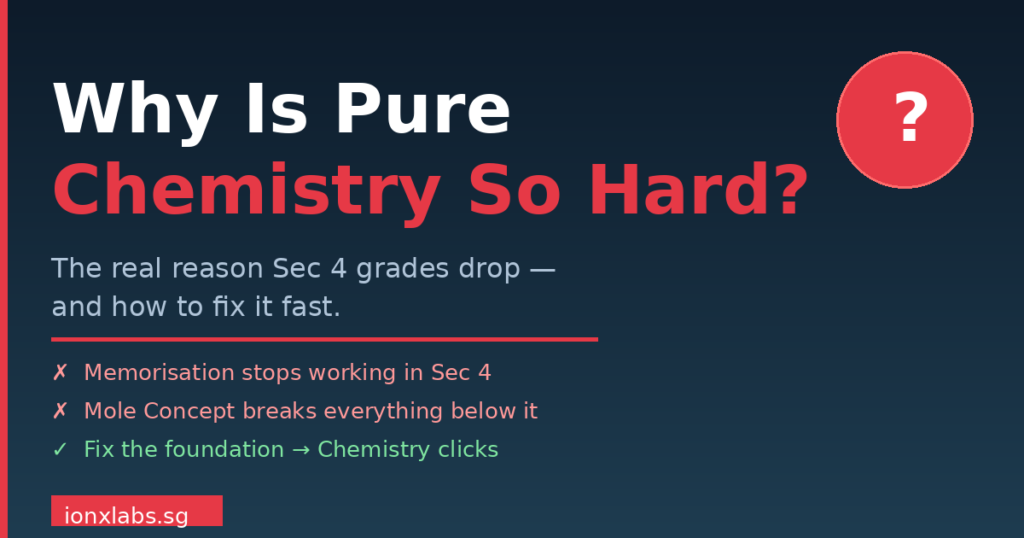
1. Why is Pure Chemistry So Hard? It stops rewarding memorising
In lower secondary science, you could survive by memorising. In Pure Chemistry, memorisation alone stops working. You’re now expected to apply concepts across topics, connect ideas, and explain why something happens. According to the SEAB O Level Chemistry syllabus, students are assessed on application and analysis, not just recall. The subject becomes logic-based, not recall-based.2. The Mole Concept becomes a make-or-break topic
This is why Pure Chemistry is so hard for most Sec 4 students — the mole concept. Most students memorise formulas like n = m / Mr without understanding what a mole actually is.- 1 pair = 2 items
- 1 dozen = 12 items
- 1 mole = 6.02 × 10²³ particles
3. Sec 4 questions are multi-step and indirect
This is another reason why Pure Chemistry is so hard — questions rarely say “Find the number of moles.” Instead, you get a scenario: a metal reacts with acid, a gas is collected, a solution is titrated and you must work backwards. If you panic at the first step (equation / mole ratio), the whole question collapses.4. Answering technique is where marks are won or lost
Pure Chemistry is not only about getting the final answer, it’s about earning method marks and explanation marks. Examiners look for key terms and logical linking. Many students know the concept but lose marks because their phrasing is vague or incomplete.5. The real reason Pure Chemistry feels so hard in Sec 4
Sec 3 is often more guided. Sec 4 combines topics and removes scaffolding. So it feels like you “suddenly became bad,” when actually the exam demands simply increased. Without a structured foundation, every new chapter becomes overwhelming and the stress snowballs.So… can this be fixed?
Yes and usually faster than students expect. The solution isn’t “do more TYS.” The solution is:- Rebuild the mole concept properly (check out our Mole Concept Sec 4 guide — 4 Mole Triangles so you never memorise equations again)
- Standardise your working format so method marks become automatic
- Get feedback from your teachers/tutors to see if you are on the right track
What to do next (fastest path)
Many students ask why Pure Chemistry is so hard even after studying — the answer is always foundation. Fix it now, especially mole concept, equations and structured answering. Once patterns are clear and concepts are organised, Chemistry becomes predictable. And predictable subjects are beatable.Frequently Asked Questions
What makes Pure Chemistry difficult in Sec 4?
Pure Chemistry becomes harder in Sec 4 because questions require multi-step application instead of memorisation. Topics like mole concept, stoichiometry and structured explanations are tested together, so weak foundations quickly affect performance.
Is the mole concept really that important?
Yes. The mole concept is the foundation of quantitative chemistry. A mole is simply a counting unit (6.02 × 10²³ particles), but it connects mass, volume and concentration. If students do not understand mole ratios properly, many exam questions become difficult.
Why do my grades suddenly drop in Sec 4?
In Sec 3, questions are more guided. In Sec 4, questions become indirect and multi-step. Students must link concepts across topics, and poor answering structure often leads to lost method marks.
Is Pure Chemistry about memorising or logic?
It is mostly logical understanding. While some definitions must be memorised, most marks are awarded for applying concepts clearly and explaining reasoning accurately.
How should I practise for O Level Pure Chemistry?
Focus on mastering foundations first (especially mole concept and equation writing). Then practise structured questions under timed conditions. Review mistakes carefully instead of repeatedly doing new papers without reflection.
When should I seek help for Pure Chemistry?
If your grades drop significantly in Sec 4 or you feel lost in quantitative topics, early intervention is important. Fixing foundational gaps before Prelims prevents long-term grade decline.
Can tuition really help improve Pure Chemistry results?
Yes, when the focus is on rebuilding concepts and improving answering technique. Structured guidance helps students understand patterns, avoid common mistakes and gain confidence in exam settings.
What topics are commonly tested in O Level Pure Chemistry?
Common high-weight topics include mole concept, stoichiometry, acids and bases, redox reactions, electrolysis and qualitative analysis. Strong understanding of these topics significantly improves exam performance.
How can I improve my answering technique for Pure Chemistry?
Improving answering technique requires understanding what examiners look for. Students must use correct scientific keywords, show clear working for calculations, and structure explanations logically. Reviewing marking schemes and learning common phrasing patterns can significantly improve scores.
Is it too late to improve Pure Chemistry in Sec 4?
No, it is not too late. Many students see improvement within a few months once foundational gaps are identified and corrected. With focused revision, consistent practice, and structured guidance, significant grade improvement before O Levels is still possible.