
What Is Cell Biology? 5 Proven Facts Every O Level Student Needs to Know
If you’ve just started O Level Biology in Singapore, one of the very first topics you’ll encounter is cell biology — and for good reason. Cell biology is the study of life at its most fundamental level. And if you’ve been asking yourself what is cell biology and why it takes up so much of the syllabus — you’re in the right place. Understanding cell biology is not just about memorising diagrams. It is the foundation that every other Biology topic builds on.
In this guide, we’ll break down what is cell biology, why it matters for your O Level exams, and how to approach it so that the rest of the syllabus starts to make sense.
What Is Cell Biology?
Cell biology is the branch of science that studies the structure, function, and behaviour of cells. Cells are the smallest unit of life — every living organism, from bacteria to human beings, is made up of cells.
So what is cell biology in practical terms for O Level students? It means understanding what each part of the cell does, how cells are organised, how they divide, and how they interact with their environment. This knowledge underpins almost every other topic in the O Level Biology syllabus — from nutrition and transport to reproduction and genetics.
You can refer to the official SEAB O Level Biology syllabus (6093) to see exactly how cell biology fits into the full examination framework.
Why Is Cell Biology So Important for O Level Biology?
Cell biology isn’t just the first chapter — it is the foundation of O Level Biology. Without a solid grasp of cell biology, every topic that follows becomes significantly harder. Here’s why it matters:
- Nutrition and digestion rely on understanding how cells absorb and process nutrients
- Transport in plants and animals depends on how cells move substances across membranes
- Genetics and reproduction are rooted in how cells divide and pass on DNA
- Disease and immunity are explained through how cells recognise and respond to pathogens
In short, if your cell biology foundation is weak, every topic that follows becomes harder. Getting this right early is one of the smartest things an O Level Biology student can do.
5 Proven Facts About Cell Biology Every O Level Student Must Know
Fact 1: All Living Things Are Made of Cells
This is the foundation of the cell theory — one of the most important principles in Biology. Every living organism is composed of one or more cells, and all cells come from pre-existing cells. At O Level, you need to know this principle and be able to explain it in the context of exam questions.
Fact 2: Animal and Plant Cells Have Key Differences
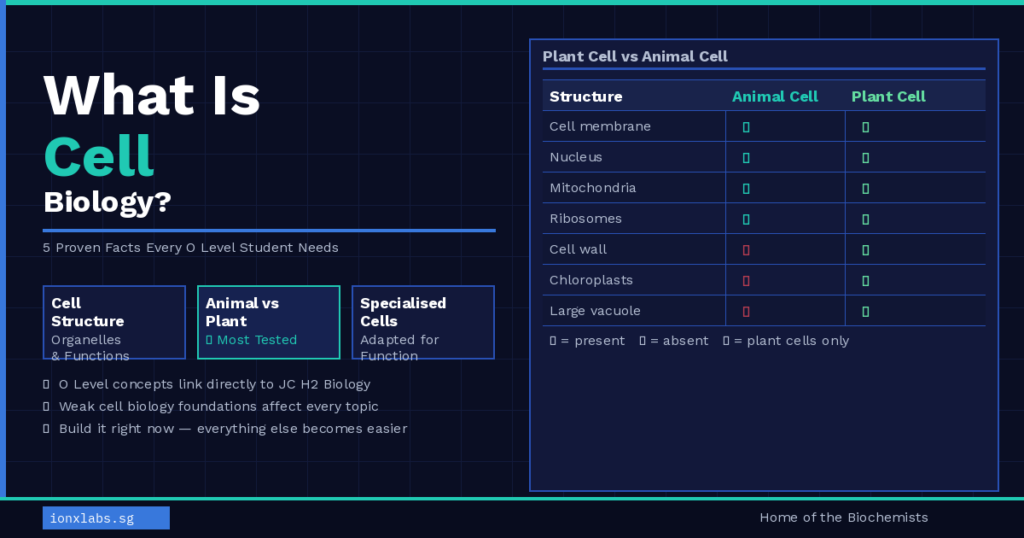
One of the most commonly tested areas in O Level Biology is the comparison between animal and plant cells. Both contain a nucleus, cell membrane, cytoplasm, mitochondria, and ribosomes. But plant cells also have a cell wall, vacuole, and chloroplasts — structures that animal cells do not have.
| Structure | Animal Cell | Plant Cell |
|---|---|---|
| Cell membrane | ✓ | ✓ |
| Nucleus | ✓ | ✓ |
| Mitochondria | ✓ | ✓ |
| Cell wall | ✗ | ✓ |
| Chloroplasts | ✗ | ✓ (in green parts) |
| Large vacuole | ✗ | ✓ |
Expect at least one question on this comparison in almost every O Level Biology exam paper.
Fact 3: Each Organelle Has a Specific Function
One of the most important cell biology skills at O Level is being able to link each organelle to its function. This is where most cell biology exam marks are won or lost. Here’s a quick reference:
- Nucleus — controls cell activities and contains DNA
- Cell membrane — controls what enters and exits the cell
- Mitochondria — site of aerobic respiration, produces energy (ATP)
- Ribosomes — site of protein synthesis
- Chloroplasts — site of photosynthesis in plant cells
- Vacuole — stores cell sap, helps maintain turgor pressure in plants
- Cell wall — provides structural support and shape to plant cells
A common exam trap is asking students to explain what would happen to a cell if a specific organelle were removed. Practise these “what if” questions regularly.
Fact 4: The Cell Membrane Controls Movement of Substances
The cell membrane is selectively permeable — it allows some substances to pass through while blocking others. This is directly linked to the topics of diffusion, osmosis, and active transport, which are heavily tested in O Level Biology.
Understanding the cell membrane at this stage will make the transport chapter significantly easier. The SEAB Biology syllabus links cell membrane structure directly to the transport topic, so these two sections should always be studied together.
Fact 5: Specialised Cells Are Adapted for Specific Functions
Not all cells look the same. O Level Biology also requires you to understand how certain cells are specialised — their structure is modified to carry out a particular function efficiently. Examples include:
- Red blood cells — biconcave shape, no nucleus, packed with haemoglobin to carry oxygen
- Root hair cells — long extensions to increase surface area for water absorption
- Ciliated cells — hair-like cilia on surface to move mucus in the respiratory tract
- Palisade cells — packed with chloroplasts near the top of a leaf to maximise photosynthesis
These specialised cell questions often appear as structured questions in Paper 2, asking students to explain how a cell’s structure relates to its function.
How to Study Cell Biology Effectively for O Level
Understanding what is cell biology is just the first step. Here’s how to study it so that it actually sticks:
Draw and Label Cell Diagrams Repeatedly
The best way to remember organelles and their positions is to draw cell diagrams from memory. Don’t just copy from a textbook — close the book and redraw. Check yourself. Do this a few times a week and cell structure will become second nature.
Learn Functions in Context, Not in Isolation
Instead of memorising “mitochondria = energy”, practise writing full exam-style answers: “The mitochondria is the site of aerobic respiration, where glucose is broken down to release ATP for cellular activities.” This trains you to write the kind of complete, mark-worthy responses examiners are looking for.
Connect Cell Biology to Every Other Topic
Every time you start a new Biology topic, ask yourself: which part of cell biology does this connect to? Photosynthesis? That’s chloroplasts. Digestion? That’s enzymes made by ribosomes. Genetics? That’s the nucleus and DNA. This habit builds the kind of deep understanding that separates A1 students from the rest.
Struggling With O Level Biology? Build Your Foundation Now
Cell biology is one of those topics where a shaky foundation creates problems for every chapter that follows. Students who invest time in cell biology early consistently outperform those who rush past it. Many students who struggle with later topics like genetics, transport, or ecology can trace the difficulty back to an incomplete understanding of cell biology.
At IONX Labs Learning Centre, our O Level Biology classes are structured to build students from the ground up — starting with cell biology and making sure every concept is genuinely understood before moving forward. Our tutors use real exam questions and targeted practice to ensure students know exactly how to answer what the examiners are looking for.
If you’re also taking O Level Chemistry alongside Biology, you might find our post on what is organic chemistry a useful companion read — many students find the two subjects reinforce each other when studied together.
Ready to Build a Strong O Level Biology Foundation?
If you’ve been looking for a clear answer to what is cell biology and how to master it for your O Levels, IONX Labs is here to help. Our Biology classes are small, focused, and built around the Singapore O Level Biology syllabus.
📲 WhatsApp us today to find out more or to book your first session.
No pressure — just a conversation about how we can help your child score better in Biology.
Frequently Asked Questions
What is cell biology in simple terms?
Cell biology is the study of the structure, function, and behaviour of cells — the smallest unit of life. For O Level Biology students, it means understanding what each organelle does, how animal and plant cells differ, and how cells interact with their environment.
Is cell biology hard for O Level students?
Cell biology can feel overwhelming at first because of the number of organelles and functions to memorise. However, once students understand how each part of the cell connects to a function, it becomes very manageable — and it makes every other Biology topic easier to understand.
What are the differences between plant and animal cells?
Both plant and animal cells have a nucleus, cell membrane, cytoplasm, mitochondria, and ribosomes. Plant cells additionally have a cell wall, chloroplasts, and a large permanent vacuole — structures that animal cells do not have.
How much of the O Level Biology paper covers cell biology?
Cell biology is tested directly as its own topic and also indirectly through related topics like transport, photosynthesis, and respiration. It appears across both Paper 1 (MCQ) and Paper 2 (structured questions), making it one of the most important foundations in the entire syllabus.
Where can I find the official O Level Biology syllabus?
You can download the official SEAB O Level Biology syllabus (6093) directly from the SEAB website at https://www.seab.gov.sg/files/O%20Lvl%20Syllabus%20Sch%20Cddts/2025/6093_y25_sy.pdf