
Many students who score well in O-Level Chemistry are surprised by how different A-Level Chemistry feels. The jump is significant — and understanding exactly what changes between O level chemistry vs A level chemistry can motivate students to build stronger foundations at O-Level before it’s too late.
In this guide, we break down the 5 key differences between O level chemistry vs A level chemistry, and explain why your O-Level results matter more than you think.
At IONX Labs, we specialise in O-Level Pure Chemistry tuition to ensure students don’t just pass — but are genuinely prepared for what comes next.
1. O Level Chemistry vs A Level Chemistry: Electronic Configuration
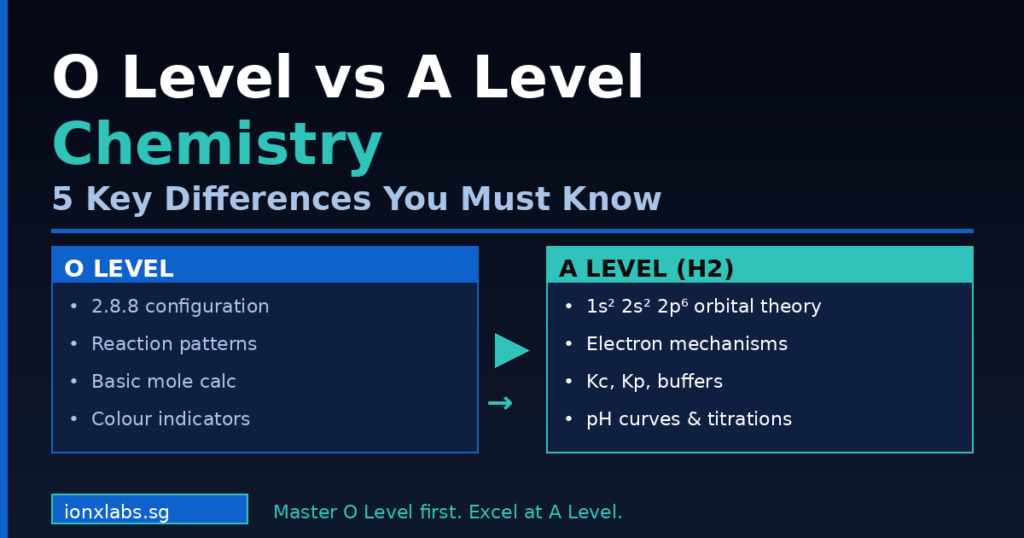
This is one of the clearest examples of how O level chemistry vs A level chemistry differ in depth. At O-Level, students learn the simplified shell model — electrons filling the first three shells as 2, 8, 8. For example, chlorine is written as 2.8.7.
At A-Level H2 Chemistry, this is replaced entirely by subshell notation: 1s² 2s² 2p⁶ 3s² 3p⁵. Students must understand orbital shapes (s, p, d), electron spin, and Hund’s rule.
The O-Level version is a stepping stone — but students who never understood why electrons fill shells will struggle when the model becomes more complex. According to the SEAB O Level Chemistry syllabus, conceptual understanding is already expected at O-Level.
2. O Level Chemistry vs A Level Chemistry: Organic Reactions
At O-Level, organic chemistry focuses on learning reaction types — combustion, addition, substitution, esterification — and knowing the conditions and reagents for each. It is manageable with good notes and consistent practice.
At A-Level, the same reactions are taught again — but now students must understand the electron movement behind every step. Nucleophilic substitution, electrophilic addition, and carbocation stability are all tested.
Students who memorised organic chemistry at O-Level without understanding the logic will find A-Level extremely difficult. This is why we stress deep understanding through our O Level pure chemistry tuition — not just memorisation.
3. O Level Chemistry vs A Level Chemistry: The Mole Concept Gets Harder
The mole concept at O-Level is already one of the most challenging topics for Sec 4 students. You can read more about it in our Mole Concept Sec 4 guide.
At O-Level, students calculate moles, masses, volumes, and concentrations using the core formulas. At A-Level, these same foundations are applied to titration curves, buffer solutions, Kc and Kp equilibrium expressions, and thermodynamic calculations.
A student who is shaky on basic mole calculations at O-Level will find these A-Level applications nearly impossible. The gap between O level chemistry vs A level chemistry here is not the concept itself — it’s the complexity of how it’s applied.
4. Acids and Bases: Colour Changes vs pH Curves
At O-Level, acids and bases are taught through properties, reactions with metals and carbonates, and indicators. Students identify if a substance is acidic or basic — relatively straightforward.
At A-Level, Brønsted-Lowry theory, Ka and Kb values, buffer calculations, and pH titration curves are introduced. Students must understand why weak acids behave differently from strong acids mathematically.
The conceptual leap is enormous — and students who didn’t fully grasp O-Level acid-base chemistry will hit a wall fast.
5. Exam Style: Recall vs Application
At O-Level, many marks can be earned through well-memorised definitions, balanced equations, and structured responses. Hard work and good notes go a long way.
At A-Level, the exam is designed to catch students who only memorise. Questions present unfamiliar scenarios and ask students to apply principles they’ve never seen before.
Higher-order thinking — analysis, evaluation, and synthesis — is tested throughout. This mindset shift is perhaps the biggest difference in O level chemistry vs A level chemistry, and it starts with how you study at O-Level.
Why Your O-Level Chemistry Results Matter So Much
To even take H2 Chemistry at A-Level, most Junior Colleges require at least a B3 or better in O-Level Chemistry. But beyond the grade requirement, the habits and understanding you build at O-Level directly determine how well you cope at A-Level.
Students who understand their O-Level content deeply — not just enough to pass — are the ones who transition smoothly. Those who scraped by on memorisation often find themselves completely lost in JC1.
This is why investing in strong O level pure chemistry tuition now is one of the best decisions a Sec 3 or Sec 4 student can make.
Conclusion
When comparing O level chemistry vs A level chemistry, the difference is not just difficulty — it’s a fundamental shift in how the subject is studied, applied, and examined.
Electronic configuration, organic mechanisms, mole applications, acid-base theory, and exam technique all evolve significantly. The students who succeed at A-Level are the ones who built genuine understanding at O-Level — not just grades. Start strong, and the path ahead becomes much clearer.
Frequently Asked Questions
What is the biggest difference between O level chemistry vs A level chemistry?
The biggest difference is depth of understanding. O-Level uses simplified models like 2.8.8 electronic configuration, while A-Level replaces these with subshell notation (1s² 2s² 2p⁶) and requires critical thinking over memorisation.
Do I need a good O-Level Chemistry grade to take H2 Chemistry?
Yes. Most Junior Colleges require at least a B3 in O-Level Chemistry to take H2 Chemistry. More importantly, weak O-Level foundations will make A-Level content significantly harder to cope with.
Is the mole concept tested differently at A-Level?
Yes. At O-Level the mole concept covers basic calculations of mass, volume and concentration. At A-Level, the same foundations are applied to buffer solutions, Kc and Kp expressions, and thermodynamic calculation, making O-Level mastery essential.
Why do students who scored well at O-Level still struggle at A-Level Chemistry?
Usually because they relied on memorisation rather than genuine understanding. A-Level exams test application to unfamiliar scenarios, so students who memorised without understanding hit a wall quickly in JC1.
Is organic chemistry harder at A-Level than O-Level?
Significantly. At O-Level you learn reaction types and conditions. At A-Level you must understand the electron movement behind every reaction: nucleophilic substitution, electrophilic addition, and carbocation stability are all tested.
How early should I start preparing for the O level chemistry vs A level chemistry jump?
Ideally from Sec 3. Building deep conceptual understanding early, rather than cramming for O-Levels, means you enter JC with the right thinking habits already in place.
Can O-Level Pure Chemistry tuition help me prepare for A-Level Chemistry?
Absolutely. Strong O-Level tuition builds the exact foundations A-Level demands — conceptual clarity, mole calculations, organic logic, and exam technique. Students who invest early transition to A-Level with far greater confidence.