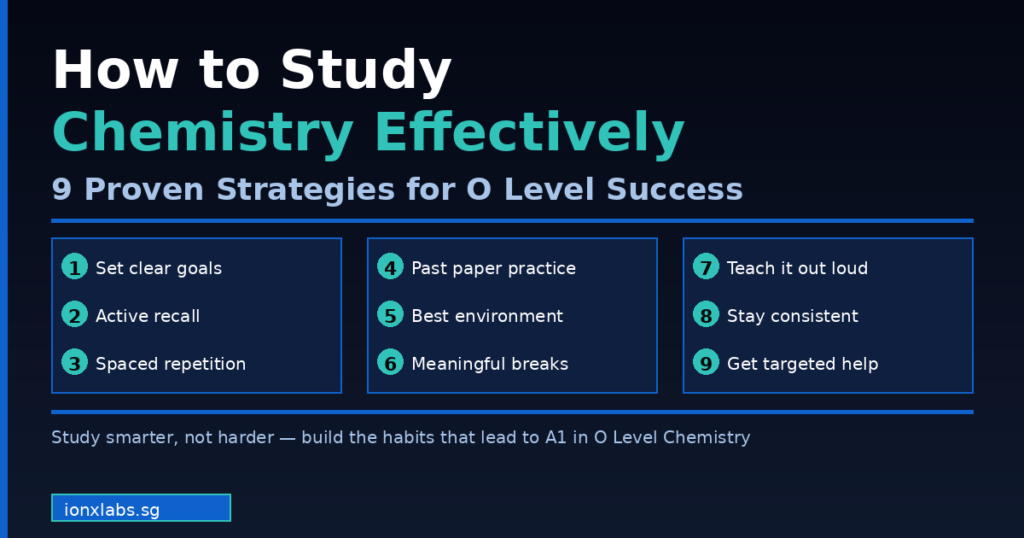
How to study chemistry effectively is a question every O Level student asks at some point. Studying Chemistry doesn’t have to mean endless hours staring at textbooks hoping something sticks. With the right strategies, you can learn more efficiently, retain more information, and actually understand what you’re studying. Here are 9 proven strategies to make your Chemistry study sessions genuinely work for you.
1. Set Clear Goals Before Every Session
Before you start, ask yourself:
What do I want to achieve today? Whether it’s mastering mole calculations or understanding organic reaction mechanisms, having a specific target keeps you focused. Vague study sessions produce vague results.
2. Use Active Recall — Not Passive Reading
Rereading your notes feels productive but isn’t. Instead, close your book and try to write down or explain what you just read without looking. This is how to study chemistry effectively — force your brain to retrieve information rather than just recognise it. It’s harder, but it sticks far longer.
3. Space Out Your Revision
Don’t cram the night before. Chemistry builds progressively — topics like chemical bonding feed into organic chemistry, which feeds into reaction mechanisms. Spacing your revision over several days using flashcards or apps like Anki means you review each topic just before you’re about to forget it, which is proven to improve long-term retention.
4. Practise With Past Papers Early
One of the most effective ways to study O Level Chemistry is to attempt past exam papers — not just at the end, but throughout your revision. Past papers reveal how questions are worded, what command words like “describe”, “explain”, and “deduce” actually require, and where your real gaps are. According to the
SEAB O Level Chemistry syllabus, application and analysis are heavily tested — so practising application early is essential.
5. Find Your Best Study Environment
Do you focus better in silence or with ambient noise? At a desk or in a library? Test different environments and find what works for you. A consistent, distraction-free space signals to your brain that it’s time to focus — which matters especially for demanding subjects like
O Level Pure Chemistry.
6. Take Meaningful Breaks
Studying for hours without rest leads to diminishing returns. Try the Pomodoro technique: 25 minutes of focused study followed by a 5-minute break. After four rounds, take a longer 15–30 minute break. Your brain needs downtime to consolidate what it has just processed — especially for complex Chemistry concepts.
7. Teach What You’ve Learned
One of the best answers to how to study chemistry effectively is deceptively simple: teach it. Explain a concept out loud to yourself, a friend, or a family member. If you can teach ionic bonding or the mole concept clearly without referring to your notes, you genuinely understand it. If you can’t, you know exactly what to revisit.
8. Stay Consistent, Not Perfect
It’s better to study 30 minutes a day than 5 hours once a week. Build a habit. Even on low-energy days, a short focused session keeps your brain engaged and maintains momentum. Consistency across the Sec 3 and Sec 4 years is what separates students who struggle from those who score A1 at O Levels.
9. Get Targeted Help When You’re Stuck
If you’ve hit a wall on a particular topic — organic chemistry, redox, or calculations — don’t let it sit. Misconceptions left unaddressed compound over time. The right guidance at the right moment can unlock understanding that hours of solo study can’t. That’s exactly what structured
O Level pure chemistry tuition is designed to provide. You can also read our
guide on why Pure Chemistry feels so hard to understand the most common stumbling blocks.
Conclusion
Knowing how to study chemistry effectively isn’t about studying more — it’s about studying smarter. Active recall, spaced repetition, consistent practice, and targeted support all compound over time. Start building these habits now, and the results will follow.