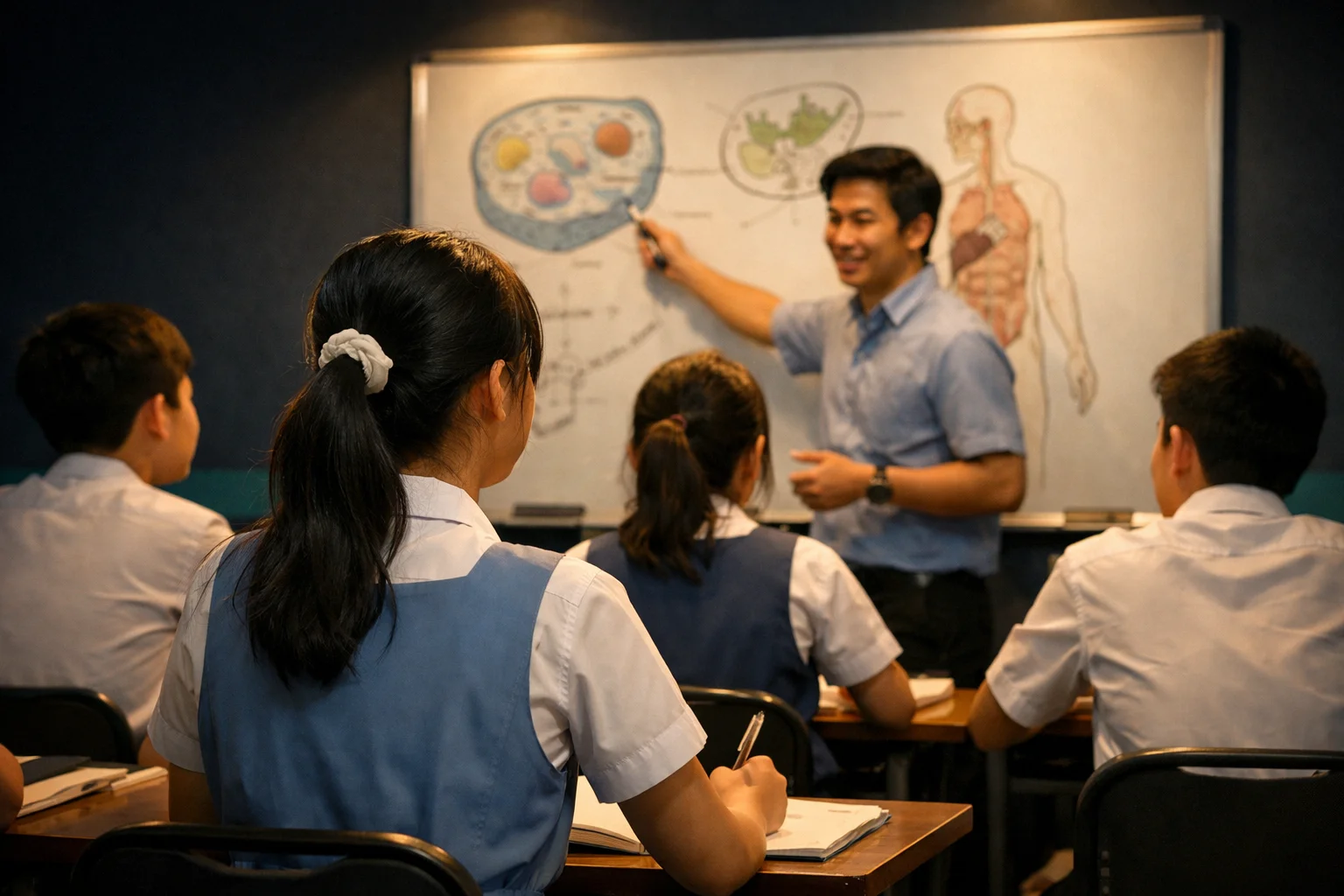
Biology tuition Singapore searches spike every year around mid-Sec 3 and early Sec 4, the point where students who have been managing with self-study start to feel the ceiling. O Level Pure Biology rewards students who understand how living systems connect, not just those who can recall facts. That depth of understanding is genuinely hard to build alone.
This guide covers 4 reasons why self-study alone falls short for O Level Biology in Singapore, and what to look for when choosing biology tuition Singapore that actually produces results.
You can refer to the official SEAB O Level Biology syllabus (6093) to see the full scope of what O Level Biology students are expected to master.
Reason 1: Biology Requires Connections Across Topics That Self-Study Misses
The biggest challenge in O Level Biology is not the volume of content. It is the fact that topics are deeply interconnected, and exam questions routinely test those connections. A question on kidney function may require you to apply osmosis principles. A genetics question may build on your understanding of mitosis and meiosis. A question on the nervous system may connect to cell membrane transport.
Self-study from textbooks naturally leads students to revise one chapter at a time. Biology tuition Singapore that is well-structured builds these cross-topic connections deliberately, so when a student sees an unfamiliar application question in the exam, they have a framework to work through it.
Understanding how diffusion and osmosis work at the cell level, covered in our guide on diffusion and osmosis O level, directly underpins topics like digestion, the nervous system, and kidney function. Students who treat these as separate chapters miss the connecting logic entirely.
Reason 2: Diagram Questions Cannot Be Revised From Notes Alone
O Level Biology papers are heavily diagram-based. Students are regularly asked to label diagrams, draw structures from memory, interpret experimental diagrams, and complete diagrams of processes like mitosis, the reflex arc, or the digestive system. These skills require repeated drawing and checking against mark schemes. Reading notes does not develop them.
Self-study students almost universally underinvest in diagram practice because it feels slower than reading. The result is predictable: they understand the concept but cannot execute the diagram under exam conditions, losing 3 to 6 marks per question.
Biology tuition Singapore that incorporates regular diagram drilling, with immediate feedback on accuracy, closes this gap far faster than solo revision. Our guide on the human nervous system O level is a good example of a topic where diagram execution matters as much as conceptual understanding.
Reason 3: Application Questions Require Guided Practice to Master
The most mark-rich questions in O Level Biology Paper 2 are application questions, novel scenarios that require students to apply biological principles to situations they have never seen before. These cannot be prepared for by memorising model answers, because each one is different by design.
Developing the ability to answer application questions requires exposure to a wide range of past paper scenarios, coached discussion of how to approach unfamiliar stimuli, and feedback on where reasoning breaks down. This is a guided process, and it is the area where biology tuition Singapore produces the clearest advantage over self-study.
Topics like mitosis and meiosis O level and human digestion O level both generate frequent application questions, asking students to explain observations from experiments or predict outcomes from novel scenarios. Tuition builds the reasoning framework needed to tackle these reliably.
Reason 4: Marking Scheme Language Is a Skill in Itself
O Level Biology examiners mark to precise mark schemes. A student who understands photosynthesis but writes "the plant uses sunlight to make food" earns nothing on a question asking for the word equation. The expected answer is "carbon dioxide + water → glucose + oxygen", together with the condition that light energy and chlorophyll are present. That requires knowing not just the concept but the exact language and format examiners accept.
Students who check their answers against the textbook rather than past paper mark schemes develop a false sense of confidence. They understand the topic but are not learning to write answers in the way examiners reward. Biology tuition Singapore that drills mark scheme language as a core part of every lesson converts understanding into marks.
This matters most for topics like photosynthesis O level and cell biology O level, where precise terminology, such as chlorophyll, chloroplast, stomata and limiting factors, is often the difference between full marks and half marks.
What to Look For in Biology Tuition Singapore
Not every biology tuition Singapore centre delivers the same results. Here is what actually matters:
- O Level specialisation: a centre with deep expertise in the exact O Level Biology syllabus will have more targeted past paper resources than one covering many levels at once
- Small class sizes: individual feedback on diagram work and written answers requires small groups. Classes of 8 or fewer allow the tutor to check every student's work every session
- MOE teaching experience: a tutor who has taught in MOE schools understands how school assessments are structured and what examiners look for in marking
- Cross-topic teaching: the best biology tuition Singapore explicitly connects topics across the syllabus rather than teaching each chapter in isolation
- Mark scheme drilling: lessons should include regular past paper practice with feedback against actual SEAB mark schemes, not just textbook answers
Is Self-Study Completely Useless for O Level Biology?
Not at all. Self-study is valuable for building initial familiarity with content, reviewing notes before lessons, and doing independent past paper practice. The most effective students combine structured biology tuition Singapore with disciplined self-study between sessions, using tuition to build frameworks and self-study to reinforce them.
The students who struggle are those who rely on self-study alone for the full preparation cycle, from first exposure to exam-ready. That is where the gaps emerge, and where biology tuition Singapore fills them most effectively.
Find Out If Biology Tuition Singapore Is Right for Your Child
At IONX Labs, O Level Biology classes are capped at 8 students. Every session covers cross-topic connections, diagram drilling, and mark scheme practice. No commitment, just a trial class.
WhatsApp to Book → More Info