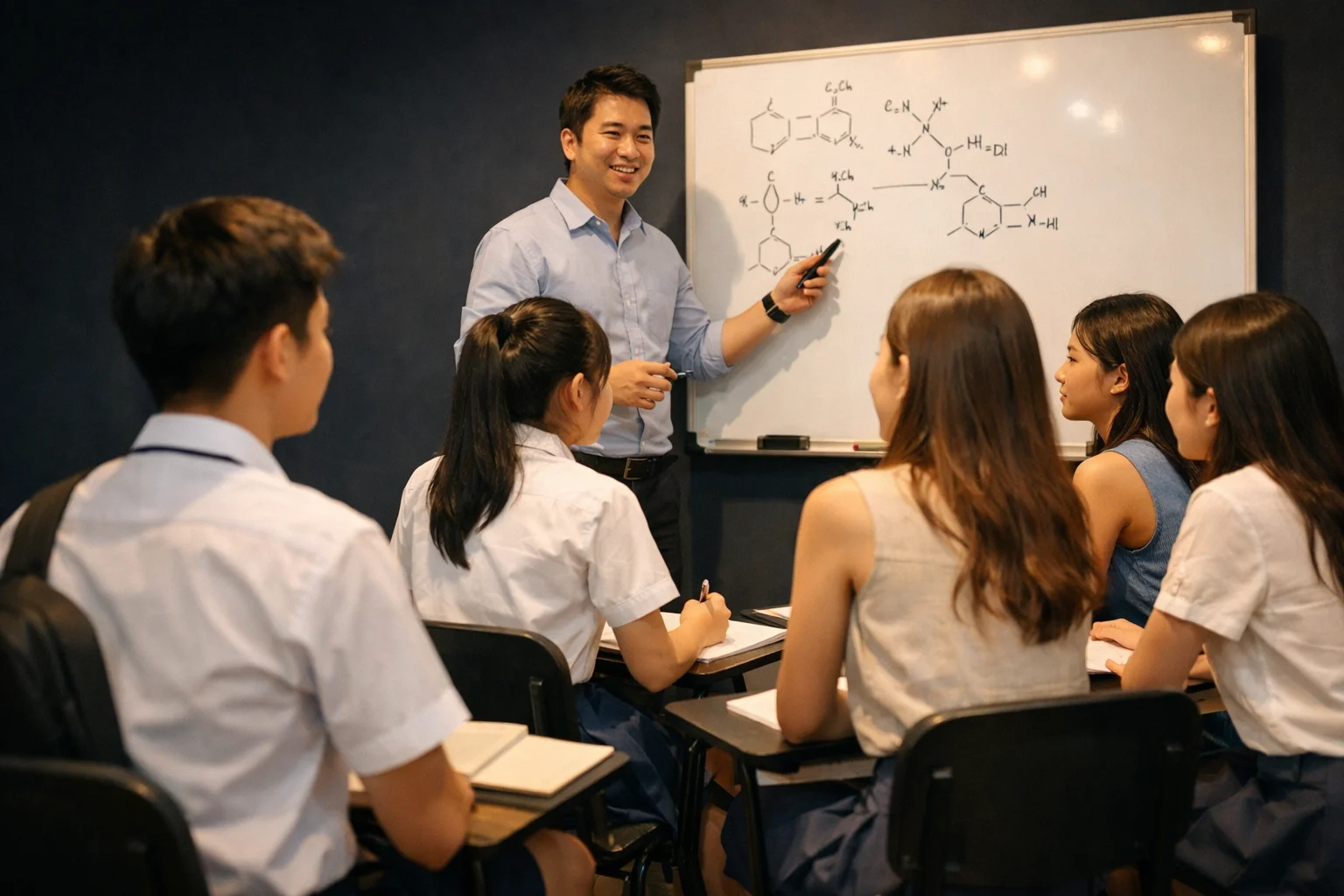
Chemistry tuition Singapore is something parents search for every year, and there is usually a real reason behind it. O Level Pure Chemistry is one of the most demanding subjects in the Singapore secondary school curriculum, and the gap between what school teaches and what top scorers actually know is wider than most parents realise. If your child is attending school diligently but still struggling to hit B3 or above, the problem is rarely effort. It is almost always approach.
This post breaks down 5 reasons why school chemistry alone is not enough for Singapore O Level students, and what to look for when choosing chemistry tuition Singapore that actually moves grades.
Reason 1: Class Sizes Make Individual Help Impossible
The average secondary school chemistry class in Singapore has 30 to 40 students. One teacher. Forty-minute lessons. Even the most dedicated school teacher physically cannot give each student the attention they need to work through individual misconceptions.
In chemistry, misconceptions compound. A student who does not fully grasp the mole concept in Sec 3 will struggle with stoichiometry, which feeds into acids and salts calculations, which then undermines electrolysis questions. By the time a parent notices the problem, the student may be three or four topics behind without knowing why.
Quality chemistry tuition Singapore centres address this with small class sizes. At IONX Labs, classes are capped at 8 students, meaning every student gets regular individual check-ins and no misconception goes unaddressed. If you have already seen this pattern developing, our post on why Pure Chemistry feels so hard in Sec 4 explains exactly how these knowledge gaps form.
Reason 2: School Lessons Prioritise Coverage Over Mastery
Singapore school teachers are bound by the MOE curriculum calendar. They must cover the entire syllabus by a fixed date, which means moving on regardless of whether every student has mastered the previous topic. This is not a criticism of school teachers. It is a structural reality of the system.
The result is that students who need two or three additional exposures to a concept before it clicks never get them in school. Chemistry tuition Singapore that is well-structured targets this gap, revisiting topics from a different angle, using worked examples tied to past SEAB papers, and ensuring mastery before moving on.
At IONX Labs, our O Level Chemistry curriculum is built around the SEAB Pure Chemistry syllabus (6092) rather than a generic tuition curriculum, which means every lesson maps to exactly what examiners test.
Reason 3: School Does Not Teach Exam Technique
There is a real difference between understanding chemistry and knowing how to answer O Level Chemistry exam questions. Examiners mark to specific mark schemes, and students who do not know how those mark schemes work will lose marks even when they understand the underlying concept.
Take a rates of reaction question: why does increasing temperature increase reaction rate? A student who writes "molecules move faster" and stops there loses most of the available marks. The full answer requires reference to kinetic energy, activation energy, and the frequency of successful collisions, in that order and in that language. School rarely has time to drill this level of precision.
Good chemistry tuition Singapore builds exam technique as a core part of every lesson, not an afterthought. Our guide on rates of reaction O level shows exactly the kind of model answer structure students need to internalise.
Reason 4: Pure Chemistry Jumps Significantly in Difficulty at Sec 4
Many students who coped reasonably well with Combined Science in Sec 3 are genuinely caught off guard by the step up to Pure Chemistry in Sec 4. Content volume increases, calculation topics become more layered (stoichiometry feeds into mole concept feeds into volumetric analysis), and application questions require connecting multiple topics at once.
This is not a sign that a student cannot do it. It is a sign that the transition needs structured support. Chemistry tuition Singapore built specifically around the O Level syllabus, rather than spread thinly across many levels and subjects, is better positioned to prepare students for this specific jump.
IONX Labs specialises in O Level Chemistry and Biology. Every resource, every past paper question bank, and every teaching approach is built for this stage. Our post on why Pure Chemistry suddenly feels harder in Sec 4 is the most direct breakdown of this transition we have published.
Reason 5: Motivation and Momentum Are Hard to Rebuild Alone
Chemistry is a subject where early struggles, if unaddressed, quickly harden into a fixed belief: "I am just not a chemistry person." Once a student has internalised that, even genuine effort starts to feel pointless. School teachers rarely have the bandwidth to address this alongside teaching the curriculum.
The right chemistry tuition Singapore environment does both. Small classes mean students see their peers working through the same problems, which normalises struggle and makes progress more visible. When a student gets a difficult stoichiometry question right for the first time, it changes how they see the subject.
This is why the students who benefit most from chemistry tuition Singapore are often not the ones who are completely lost. They are the students sitting at a C5 or B4 who need the right structure to break through to a consistent B3 or A2.
What to Look For in Chemistry Tuition Singapore
Not all chemistry tuition Singapore centres are equal. Here is what actually matters when evaluating options:
- Subject specialisation: a centre with deep expertise in the exact syllabus your child is sitting will out-teach one spread thinly across many levels and subjects
- Class size: anything above 12 students per class limits individual attention. The best results come from classes of 8 or fewer
- MOE teaching experience: a tutor who has taught in MOE schools understands how school assessments are structured and what examiners expect
- Syllabus alignment: lessons should map to the current SEAB syllabus, not generic content
- Track record: ask for evidence of student results, not just testimonials
IONX Labs was built around every one of these criteria. Ken is an ex-MOE teacher with an NTU Honours degree in Chemistry and Biological Chemistry, classes are capped at 8 students, and the programme is built directly on the O Level syllabus. In 2025, 80% of the cohort scored A1 to B3. Find out more about our approach on our O Level Pure Chemistry tuition page.
You can also read our detailed guide on how to study O Level Chemistry for practical strategies your child can apply immediately, with or without tuition.
Is Chemistry Tuition Singapore Right for Your Child?
If your child is in Sec 3 or Sec 4 and struggling with Pure Chemistry, or performing below where they should be, book a no-pressure trial at IONX Labs. A real lesson, a class of 8, no commitment required.
WhatsApp to Book → More Info